Showing posts with label ison comet. Show all posts

Wednesday, 30 October 2013

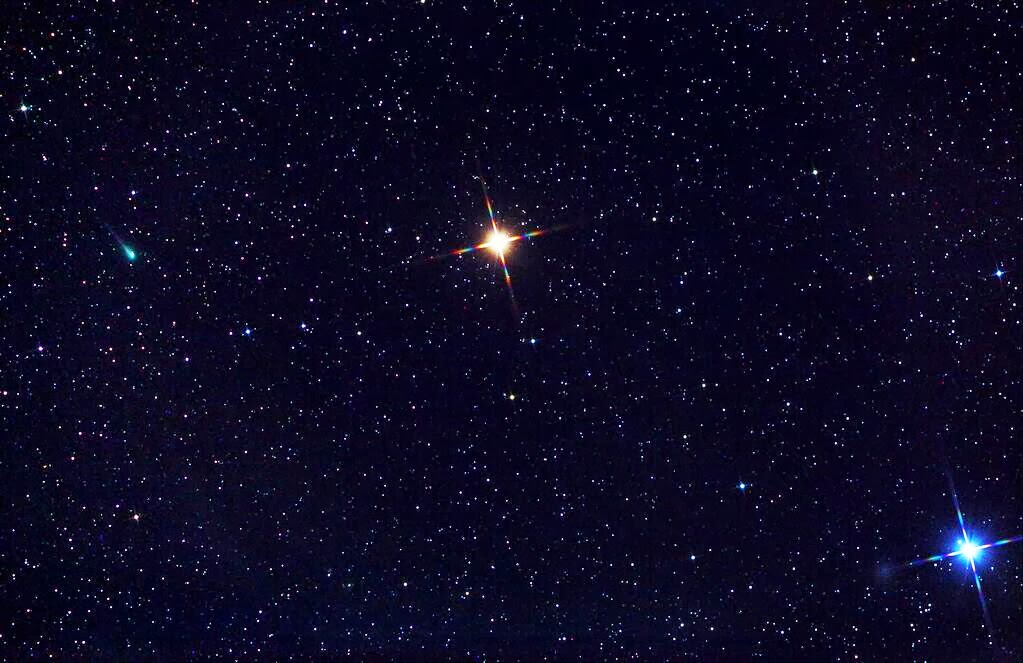
Time-lapse Video of Ison by Justin Ng

This incredible video of Ison was shot by professional photographer Justin Ng from Mersing, Malaysia. The video is a time-lapse produced over 69 minutes, shot on the 27th of October.
Justin commented that when he first spotted Ison she was glowing bright green "It's my first time seeing a comet and capturing it in motion. It's truly amazing! After I compiled the images and did a time-lapse movie for it, I'm totally in awe and speechless to see the comet moving that fast across the night sky," he said

As the video plays you can see the comet fading, this is due to the fact that the sun was starting to rise and brighting the sky causing Ison to fade from view. Eagle eyed viewers may also spot the galaxy NGC 3428 below and to the left of the two brightest stars on the left of the video.

Please be patient while the video loads, it's well worth the wait!


Normally you would not be able to see Ison moving whilst viewing the comet over such a short period of time, even though she is traveling at around 680,000 KPH but because of the very low field of view of Justins set up it allows us to see her in motion.
Justin explained:
"The primary reason why the comet appears to be moving fast across the sky within 69 minutes is because of the smaller field of view, which makes a very deep space object looks big on the screen and move faster. This is evident if you were to use any planetarium softwares and try to zoom in closely into Comet ISON, you will see its moving faster and faster as the field of view becomes narrower.
I used a 20″ telescope and a specialized monochrome CCD camera to capture it and the field of view is 0.55 degrees. This is extremely narrow and the smaller the field of view, the faster an object will appear to move. Each exposure was only 90 seconds and so when you looked into the time-lapse in the slow motion part, each frame represent the distance covered by Comet ISON within 90 seconds. Which is logical because Comet ISON is traveling at a speed of 684,000kph (425,000mph).
Currently comet is not visible to naked eyes due to its magnitude of about +8.1 and the magnitude of the 2 brightest stars are at around +7, still beyond what naked eyes can see. However there have been reports that the comet is now visible for binoculars and medium-sized telescope.
The images used in the video is what you see in the RAW files. No other editing was done besides cropping the images to fit into 1920 resolution."
Justin Ng is a spectacular photographer with many awards under his belt, his work published by BBC's Sky at Night, National Geographic, ABC, EarthSky, CNN and the Guardian to name just a few! Justin does not limit himself to astrophotography, he actually specializes and is ranked one of the very best in the world at photographing landscapes, sports and especially weddings! So if your tying the knot and fancy the best photographer in the business check out his website here 

Photo of Ison by Cliff Spohn & Terry Hancock

This amazing picture of Ison is a joint effort by astrophotographers Cliff Spohn from Ohio and Terry Hancock in Michigan. The image was captured by Cliff using his TEC 140 F7 5" refractor telescope with a QHY9 camera based in Marion, Ohio, while his mate Terry took care of the processing work.
This is not the first collaboration by the pair, You might remember they released a great video of Ison a couple of weeks ago that got us all excited, which you can see here.

Ison by Cliss Spohn & Terry Hancock

Terry Hancock commented “The first time in almost two weeks that we have had a break in the clouds and rain we could not miss this rare opportunity to capture ISON using Cliff’s equipment, Credit goes to Cliff for capturing the object while I did the calibration, stacking in CCDStack post processing in CS5 and video editing.”

Friday, 25 October 2013

Binoculars, The BCRS buyers guide


When shopping for binoculars it pays to know what your looking for and what the specifications mean.
You'll notice that binoculars have numbers such as 7x25 or 10x50 proudly printed on them. These numbers are the magnification and objective lens ratings and are obviously important, but there is so much more to consider.....

Magnification

The first number is the magnification, how much the binocular will magnify what you're looking at. It's very easy to get carried away and think bigger is better, but high magnification binoculars can be hard to hold on target and have a smaller field of view, the higher the magnification the greater the effect of handshake. Another consideration is weight, the higher the magnification, the greater the weight, the more your arms ache! 7x and 8x binoculars can be used by most people for long periods with out causing much trouble, where as anything above 10x WILL make your arms ache! 7x to 10x binoculars will be perfect for viewing Ison, and will also be good for general use.

Objective Lens or Apeture

The object lens is the bigger lens at the front of the binoculars. The rating is the size of the lens in mm, so for example a 10x50 will have a 50mm diameter lens. The object lens is an important consideration, as it will determine how much light can enter the binoculars. The more light, the brighter and clearer the image, which is especially important for night time viewing.

Exit Pupil

This is rarely given when buying binoculars, but is important none the less. Exit pupil is the amount of light which leaves the binoculars at the rear, which is the light you see! To magnify the image the light coming into the binoculars is spread which makes it dimmer. This is not usually a problem in daylight, but at night viewing dim objects you can struggle. The exit pupil is the objective lens size divided by the magnification, the higher the answer the better!
For example to work out the exit pupil of 10x50 binoculars: 50/10 =5 
If we compare that to 8x50 binoculars 50/8 = 6.25
The 8x50 binoculars will there for give a brighter image than the 10x50 even though they have the same objective lens size.

Field of view

This may be written as "field", "angle" or as a number of degrees. Most binoculars in the UK will be marked with field and have the specification below which will be something like "70m at 1000m". This means that if you were viewing a wall that was 1000 metres away, you would be able to see 70 metres of it. A larger field of view makes it easier to locate objects and to keep it in view. The benefit for comet viewing is of course being able to fit the tail in! 


Lens Coating

Most binoculars nowadays have coated lenses. Look at the objective lens and you will probably notice the lens is red, blue, green or yellow. The idea of this coating is to prevent the light from scattering which can make the image darker, in reality we have found these coatings to make very little difference when using the binoculars for astronomy. The one exception is "Ruby coated" lenses, which should be AVOIDED at all costs! I have seen these advertised as "night vision" but nothing could be further from the truth! Ruby coating actually reduces the amount of light that enters the binoculars, the opposite of what you want for night viewing!


Prisms

There are two types of binoculars which you will come across, Porro prism and Roof prism. There is not much between them when it comes to use, but there is when it comes to price. Roof prism binoculars are more expensive than Porro prism. If we had the choice of two binoculars one Porro and one Roof, both costing £100, we would rather our money went on the lenses than the prism, so we would buy the Porro's.
Its quite easy to tell the difference, look at the picture, notice the Porro's have a "step" where as the Roof binoculars are "straight"

Where to buy

The best place to buy binoculars is from astronomy shops or camera shops. Here you can get a good feel of the size and weight, which can vary dramatically between models. The advice from a good shop is also invaluable. You might have seen cheap unbranded Chinese binoculars on market stalls, and ebay but these are usually very low quality and best avoided if possible. If you are on a tight budget try second hand shops, car boot sales or even army surplus stores, but always test them well!  Even the best bins can be rendered useless if they've been dropped! Outdoor/camping shops can also throw up a bargain especially this time of year! Online optic specialist's often sell binoculars much cheaper than the high street shops, but of course you cant pick them up and make sure they fit you well.

Brands

We're not going to recommend any brands over another, but do recommend buying branded to ensure good quality. There are many manufacturers and this short list only contains a few to give you a idea of what's out there. You'll probably notice the big camera manufacturers on the list, with binoculars just like cameras, its all about the lens, and if anyone knows lenses, it's a company that makes cameras!
Top of the price range look for: Steiner, Nikon, Cannon, Celestron, Pentax, Leupold, Praktica, Lecia, Swaroski 
Bottom of the price range: Bushnell, Tasco, Minolta, Vivtar and Jason

We can not express enough that the "bottom of the price range" list is means exactly that, it is in no way to say they are lower quality, in fact my favorite binoculars are Bushnell! 
Expect to pay around £25 for a small pair of budget binoculars up to several hundred at the other end of the scale.

Conclusion

The ideal pair of binoculars will be between 7x and 10x magnification and have a objective lens of between 35 and 50mm. Binoculars which are larger will be heavy and awkward to use and may even require a tripod! Avoid astronomical binoculars they are far to large for comet watching, and useless for everyday use.
Compact binoculars usually have a 25mm or smaller objective lens and should also be avoided if your budget will allow.  If you have to go for compact, get a lower magnification to increase the exit pupil rating.

Chose a pair of binoculars that you can use not just for astronomy, but for bird and wild life watching. You might discover that you're just not in to comets, so a pair of £300 celestial binoculars would be a bad purchase! Avoid any red coating on the lenses especially ruby coating. Lastly the weight, we can not express enough how important this is! A heavy pair of binoculars can be really uncomfortable to use and at the end of the day, if your not enjoying it whats the point.............

Tuesday, 22 October 2013

How to see Ison

OK so you want to see Ison, but how to go about it?

The most important piece of equipment is simply your eyes! This may sound obvious but come the end of November in to December Ison will be more than visible to the naked eye. Ison will appear as a bright point of light low in the sky with a long tail stretching far up in to the heavens, and should be visible all across the northern hemisphere.
McNaught's Comet of 2007
The spectacular picture above is of McNaughts comet also known as "the great comet of 2007". McNaught was visible in the Southern hemisphere. We expect Ison to put on a show of similar scale, so as you can see you really don't need any fancy equipment to enjoy this amazing celestial show!

That said to view Ison before she becomes visible to the naked eye you will need to use optics, as you will if you want to see some of the finer details in her tail, the lumps of material and even jets from her surface.
There obvious choice is to run out and buy a astronomy telescope, but this would be our last choice!
So what are the options? Well it comes down to three, Binoculars, terrestrial telescopes and astronomy telescopes and we rate them in that order, and here why....

Binoculars:

People always over look binoculars when staring out in astronomy, but they are the most useful tool an astronomer can own. Firstly for someone who just wants to catch a glimpse of Ison in all her glory, you really don't want to be spending huge sums of money on a telescope.
A good pair of binoculars cost considerably less than even the cheapest telescope and are not limited to just sky watching! Binoculars are much easier to use, it takes experience and a little skill to locate a distant object with a telescope and even more to keep it tracked on, binoculars make short work of both tasks! The large field of view you get with binoculars make finding objects in the sky easy. The best place to observe anything in the night sky is out in the country, on top of a hill, away from the light pollution of the towns and cities. Unfortunately for astronomers, these are not the easiest places to get to when your carrying a 25kg telescope! No optical device likes being dropped, including binoculars, but we can tell you from experience that telescopes really, REALLY don't like falls! Binoculars on the other hand are designed for "rougher" use. Finally space, not the bit up there but the lack of it in your home! Binoculars take up no room at all and can be kept handy in your cars glove box for those unscheduled comet watching moments! Don't know much about binoculars? Don't worry, scroll down for our buyers guide!
Get a good pair of bins, your back, wallet and sanity will thank you!

Terrestrial Telescopes:

These telescopes are often used for bird watching and are also known as spotter scopes, field telescopes, birding scopes or sports scopes to name but a few. Terrestrial telescopes can be fantastic for comet watching, but do suffer from a lot of the same restrictions that an astronomy telescope does. The advantage's of a terrestrial scope is that they offer higher magnification than binoculars without being to high like a regular telescope. The field of view is also much larger than a regular telescope which makes it easier to locate and stay on objects in the sky. They are much more rugged than an astronomy telescope, smaller, lighter and easier to carry. On the down side though, they are more expensive than binoculars, harder to use, heavier and more awkward to carry and still require a tripod. Our advice is, if you have one or can borrow one take it with you. If not stick with the binoculars.....


Astronomy Telescopes:


Astronomy telescopes are designed to view far space objects, rather than near earth objects like Ison. 
The high magnification and small field of view makes it hard to locate objects in the sky and with the earths rotation, hard to keep in view. 
Telescopes don't come cheap, and the ones that do are usually very poor quality. If you have never used a telescope before, you will probably become frustrated quickly. 

Don't get us wrong telescopes are the backbone of astronomy, but for when Ison comes close, they're to big, to powerful, to clumsy!
Its all about using the right tool the the job........


You might have noticed that we recommend binoculars! But how do you go about choosing a pair? Well don't fret we've written a guide........

Friday, 18 October 2013

Photo of comet Ison and Mars Together

This fantastic image of Ison with the red planet, was taken by Ari Koutsouradis from Maryland, USA.
Ari was kind enough to provide full details of his set up and method to help anyone wanting to photograph Ison for themselves.
The photo is a composite stack of forty four, 30 second exposures at ISO1600. The camera is a Nikon 5000 mounted on a Stellarvue 80ED 80mm refractor telescope which was on a Celestron CG5-ASGT computerised tripod.


Ison with Mars taken by Ari Koutsouradis

Wednesday, 16 October 2013

Fantastic Animation of Ison from Savio Fong of the Galaxy Scientific Group

This amazing GIF animation of Ison was taken by president of the Galaxy Scientific Group, Savio Fong  from his observatory in Tibet on the 13th of October.
Savio Fong is based in Hong Kong but has a remote controlled robotic observatory in Tibet, based at an altitude of 4300m.
Savio is an incredible astrophotographer and has been producing some spectacular images of Ison and we're looking forward to seeing more of his pictures as Ison gets closer to perihelion in the next few weeks!


Ison animation by Savio Fong of the Galaxy Scientific Group

Savio was kind enough to provide details of his set up. The animation was made using twenty, 120 second exposures. He was using a FLI Proline 16803 camera on an APM 105/650 APO refracting telescope, seated on a Paramount ME robotic mount.


IMG_0013.JPG
Savio Fong's Robotic observatory in Tibet

Saturday, 12 October 2013

New image of Ison with Mars and Regulus by Norbert Mrozek

This great image of Ison was captured by astronomer Norbert Mrozek and cleaned up by the good people at comet Ison news. You can see Ison to the left of the photo, Mars in the centre while Regulus is to the right. We love the clarity of this shot as well as the glare from Mars!

Ison, Mars and Regulus by Norbert Mrozek

Saturday, 5 October 2013

New photo of Ison by Martin Mobberley

Famous British astronomer Martin Mobberley caputured these fantastic images of Ison.
Martin was using the iTelescope for these pictures. Martin Mobberley is a former president of the British Astronomical Association and currently operates International Astronomical Union Observatory 480. He was honnored by the IAU for his services to astronomy by the renamingof asteroid 7239 to "Mobberley"
He has also written a number of very good books including a biography of Sir Patrick Moore which you can find here.

Ison  05/10/2013   by Martin Mobberley


Ison  04/10/2013   by Martin Mobberley

Friday, 4 October 2013

Ison Location update 04/10/2013

These are the current co-ordinates for Ison at 19:00 GMT  04/10/2013

Co-ordinates: 09h  42m  53.8s    16* 48' 19.6"
Distance from Sun: 236,170,890 km
Distance from Earth: 304,987,829 km
Magnitude: 10.83

For those who don't know you can track Ison in real time from the comfort of your computer by visiting the fantastic The Sky live website

With thanks to The Sky Live

Thursday, 3 October 2013

Does this Photo show jets on Ison?

On Tuesday Ernesto Guido, Nick Howes and Martinao Nicolini of the Ramanzacco Observatory in Italy managed to capture the image below using the 2 metre Liverpool telescope. One of the images appear to show what is maybe a jet from Ison. Jets are formed as a comet approaches our Sun, it begins to heat up and the ice begins to change from a solid to a gas with no liquid stage. Some of the dust is left behind as the ice melts. The dust forms a dark, protective crust on the surface of the nucleus (head) and slows the melting. In some places this layer is thinner, which allows jets of gas to burst through.

Ison captured with Mars Ernesto Guido, Nick Howes and Martinao Nicolini at the Ramanzacco Observatory, Italy.

The image is a stack of twenty, 11 second exposures and clearly shows Ison developing coma and tail which is now estimated to measure at least 3 arc minutes. This is a very promising sign that Ison is developing into the comet we have been hoping for.
Talking about the image Nick Howes said: "There was some debate as to the existence of additional jet structures on the comet. Our data analysis seems to show that some reports of this were possibly spurious, however, our one process does seem to show a possible small jet, which a 2m class instrument would be able to detect. Our analysis is undergoing additional review and peer checking with our collaborators in the USA. The scientific analysis of this comet and its inner coma is ongoing, and being monitored closely."
The team at the Ramanzacco observatory have sent the images and data to the Planetary Science Institute for further analysis, and we hope to bring an update later today!

Wednesday, 2 October 2013

Ison Location Update 01/10/2013

These are the current co-ordinates for Ison at 19.36 GMT  02/10/2013

Co-ordinates: 09h  38m  29.3s    17*  14'  32.2"
Distance from Sun: 241,832,405 km
Distance from Earth: 313,735,498 km
Magnitude: 10.97

For those who don't know you can track Ison in real time from the comfort of your computer by visiting the fantastic The Sky live website

With thanks to The Sky Live

Monday, 30 September 2013

Ison update 30/09/2013

These are the current co-ordinates for Ison at 18.45 GMT  30/09/2013

Co-ordinates: 09h 34m 06.4s,   17* 40'  08.9"
Distance from Sun: 247,607,969 km
Distance from Earth: 322,707,837 km
Magnitude: 11.12

For those who don't know you can track Ison in real time from the comfort of your computer by visiting the fantastic The Sky live website

With thanks to The Sky Live

NASA Prepares for Ison's flyby of Mars

Tomorrow see's Ison reach it's closest approach to Mars. Ison is going to come within just 10,460,730 km of Mars, six times closer than it will get to Earth!
There are currently 5 active Mars missions which will be turning their attention towards Ison, 2 rovers and 3 orbiters. The best equipped to study Ison are NASA's Mars Reconnaissance Orbiter (MRO) and ESA's Mars Express Orbiter (MEO).


Artists impression of Ison from the surface ofMars

Mars Reconnaissance is equipped with the largest telescope ever taken in to deep space at 20 inches, however it was designed with surface observation, rather than imaging comets! Like wise Mars Express original purpose is also terrestrial mapping and comes equipped with the very impressive HRSC Camera. Between them MRO and MEO should give us some stunning pictures and the most in depth data on Ison so far.  We are hoping to get much more accurate data on her size, the larger she is the more likely she will survive her encounter with the Sun at the end of November.
What's more as she passes Mars she is warming up more causing her tail to grow and increasing her coma. With all these orbiters and rovers pointed in her direction, we should get a fascinating glimpse in to how chunks of ice evolve and grow into the magnificent comets we all know!

Mars Reconnaissance Orbiter


All of this is just a small part of the research being conducted on Ison. A grand total of 16 NASA craft will be observing Ison from space along with the Hubble space telescope, 4 ESA spacecraft and every observatory on Earth! Ison is without doubt the most study comet there has ever been, and we are extremely excited to find out what secrets will be unlocked!


Friday, 27 September 2013

NASA to luanch balloon to study Ison

NASA has annouced they are launch a observation balloon to monitor Ison this weekend.

BRRISON to scale with the Washington monument 
The balloon, called "BRRISON"  ( Balloon Rapid Response for Ison) will be launched from NASA's Columbia Scientific Ballon facility in Fort Sumer, New Mexico. At around 204 metre (671 feet) this helium filled polyethylene balloon is capable carrying up to 3,600 kg and reaching an altitude of 37,000 metres (120,000 feet) for approximately 11 hours.
Andy Cheng, principal investigator said "By ascending above 99.5% of the Earth's atmosphere, BRRISON will be able to study the materials within the comet," ......... "It's possible that water and organic chemicals on comets may have played an important role in the evolution of life on Earth."


BRRISON's Mission objectives:

  • Develop and demonstrate gondola and payload systems for a balloon-borne platform designed to achieve planetary science objectives.
  • Observe comet ISON in the near-infrared, near ultra-violet and visible wavelength ranges.
  • Through these observations, measure CO2 and H2O emissions and the ratio of CO2/H2O.
  • These measurements will be used as vital diagnostics of the comet’s origin and journey through our Solar System.
  • How does the composition of Oort Cloud comets compare to Kuiper Belt comets?
  • What are the chemical processes that lead to complex organic molecules in regions of star and planet formation?
  • Were there systematic chemical or isotopic gradients in early solar nebula?
  • How did Earth get its water and other volatiles?

BRRISON Facts

   
BRISSON gondola
BRRISON's Gondola and instruments
The BRRISON ballooncraft is made of two primary components.

First is the large, stratospheric helium (He) filled balloon, also referred to as a stratospheric scientific balloon, which also serves as the “launch vehicle.”
Second is the gondola, an aluminum structure which houses BRISSON’s scientific instrument payload. The payload includes a refurbished telescope with sensors in the near-infrared, near ultra-violet and visible wavelength ranges. Additionally, a student-led payload of a high-definition camera will be used for scientific and education and public outreach purposes.

  • Balloons fly above 99.5% of Earth atmosphere which results in access to spectral bands not observable from ground-based observatories (such as the Mauna Kea Observatory) or airborne platforms (such as the SOFIA aircraft).
  • The height of the balloon also means that there is an absence of turbulent air mass that can degrade the quality of images being captured by the various sensors onboard the ballooncraft.
  • Balloon-crafts provide access to near-space at a fraction of the cost of spacecraft missions.  Typical balloon mission development costs range from about $5 million to $10 million and typical balloon launch costs range from about $500,000 to about $1.5 million – a fraction of what spacecraft mission development and  spacecraft launch vehicles cost.
  • Balloon payloads can be recovered more than 95 percent of the time.  These payloads can be refurbished and re-flown multiple times.  Plus, since the payload is still within the protection of the Earth’s radiation belts, there is no need for radiation-hardened electronics.
  • Since balloon missions are developed on relatively quick time-scales (within a year or two), they are perfect training opportunities for young space engineers & scientists.


A Newbies guide to Ison part 4

What is Perihelion?

Perihelion is term we use to mean that a comet has reached its closest point to the sun. Comet Ison's perihelion is on the 28th of November at approximately 23:00 GMT when she will pass the Sun at a distance of around 1,200,000 Km (800,000 miles)


What is A.U?

A.U is a measurement of distance, and stands for Astronomical Unit.
A.U is the distance between the Earth and the Sun which is 149,597,870,700 km (92,955,807,273 miles). So if you see Ison's distance from earth as 2.0 A.U this means it is twice as far away as the Earth is from the Sun. 

Thursday, 26 September 2013

Ison update Location on 26/09/2013

These are the current co-ordinates for Ison at 20.03 GMT  26/09/2013

Co-ordinates: 09h 26m 00.5s,   18* 26'  08.2"
Distance from Sun: 258,611,145 km
Distance from Earth: 339,902,455 km
Magnitude: 11.38

For those who don't know you can track Ison in real time from the comfort of your computer by visiting the fantastic The Sky live website

With thanks to The Sky Live

Ison Photograph clearly showing tail and coma forming nicely!

Photograph of Ison by David Peach showing tail and coma
Photograph of Ison by David Peach


Damian Peach captured this amazing image of Ison on the 24th of September,as she travels between the constellations of Cancer and Leo. David Peach a highly respected British astrophotographer used a 17" corrected Dall-kirkham telescope and a Finger Lakes Instruments Camera. David will be appearing at the Comet Conference by Astronomy Now in London on the 20th of October where he will be sharing his photography tips. For more information visit the Astronomy Now site here


Wednesday, 25 September 2013

Comet Ison location update 25/09/2013

These are the current co-ordinates for Ison at 19:15 GMT  25/09/2013

Co-ordinates: 09h 23m 58.7s,   18* 37' 27.0"
Distance from Sun: 261,454,125 km
Distance from Earth: 344,360,900 km
Magnitude: 11.45

For those who don't know you can track Ison in real time from the comfort of your computer by visiting the fantastic The Sky live website

Ison's current location  25/09/2013    with thanks to The Sky Live

Ison Photographed with a 4" refractor telescope


An amatuer astronomer has photographed Ison using just a 4" refracting telescope. Even more amazing is he did it TEN days ago! This is the smallest telescope we've heard of yet viewing Ison, so well done Peter Lawrence!

Peter Lawrence took this photo of Ison with a 4" refractor telescope

"I photographed Comet ISON on Sept. 15th using my 4-inch refractor," reports astrophotographer Pete Lawrence of Selsey UK.  "The comet's tail is nicely on view even through this relatively small instrument."
"Here's a rough stack of images from the morning of 15 September showing Comet C/2012 S1 ISON imaged with a CCD camera through my 4-inch, f/9 refractor."

Have you seen Ison yet? If so we would love to here about your set up!

Tuesday, 24 September 2013

Mars Express to start imaging Ison today


The European Space Agency will give it’s Mars Express Orbiter craft a new mission tonight, to start photographing Ison. Mars Express will get some of the best views in the solar system as Ison will pass Mars at just 10.5 million kilometres, three times closer than it will get to Earth. 
Mars Express is hoped to produce the some of the best data on the composition of Ison’s corona that we will get, so we are egarly awaiting the results. Mars Express is well equipped and with such an impressive aray of instruments at the ESA disposal, we are expecting some great insights in to Isons life.

Mars express orbiter observing Ison
The Mars Express Orbiter will start observing Ison today 24/09/2013

 Surface/subsurface instruments
· HRSC (High Resolution Stereo Camera)
· OMEGA (Visible and Infrared Mineralogical Mapping Spectrometer)
· MARSIS (Sub-surface Sounding Radar Altimeter)
 Atmosphere/Ionosphere instruments
· PFS (Planetary Fourier Spectrometer)
· SPICAM (Ultraviolet and Infrared Atmospheric Spectrometer)
· ASPERA (Energetic Neutral Atoms Analyser)
  

 This is just the start of a four pronged mission from the European Space Agency to study Ison. In November the ESA/NASA SOHO mission will turn its sights on Ison, then it’s the turn of the Venus Express orbiter and the Proba-2 satellite. We will bring you more information on these missions closer the time!