Showing posts with label comet ison 2013. Show all posts

Wednesday, 30 October 2013

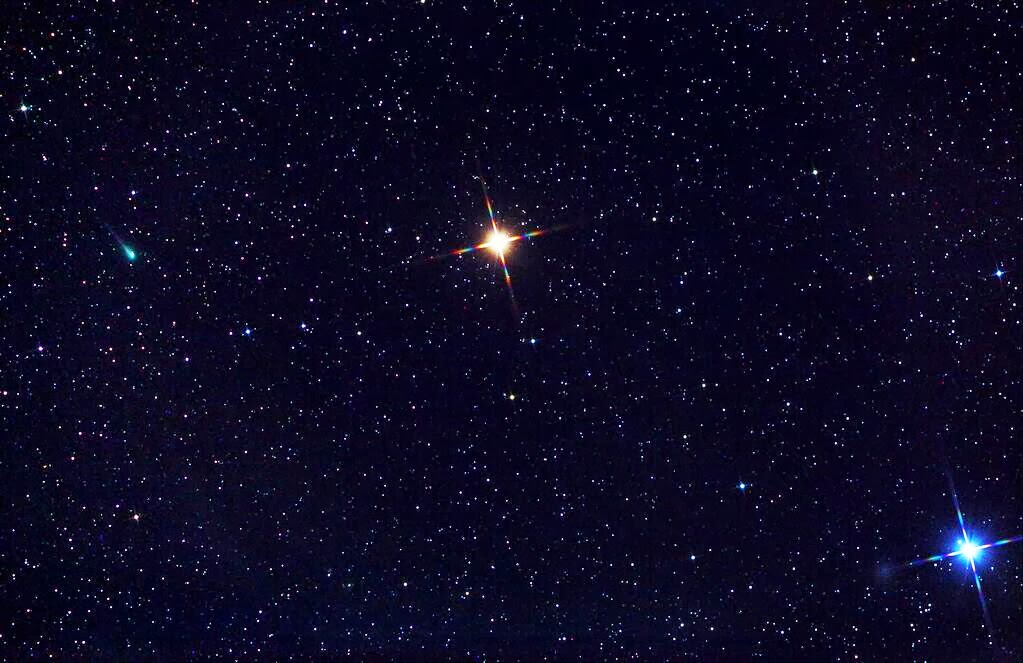
Time-lapse Video of Ison by Justin Ng

This incredible video of Ison was shot by professional photographer Justin Ng from Mersing, Malaysia. The video is a time-lapse produced over 69 minutes, shot on the 27th of October.
Justin commented that when he first spotted Ison she was glowing bright green "It's my first time seeing a comet and capturing it in motion. It's truly amazing! After I compiled the images and did a time-lapse movie for it, I'm totally in awe and speechless to see the comet moving that fast across the night sky," he said

As the video plays you can see the comet fading, this is due to the fact that the sun was starting to rise and brighting the sky causing Ison to fade from view. Eagle eyed viewers may also spot the galaxy NGC 3428 below and to the left of the two brightest stars on the left of the video.

Please be patient while the video loads, it's well worth the wait!


Normally you would not be able to see Ison moving whilst viewing the comet over such a short period of time, even though she is traveling at around 680,000 KPH but because of the very low field of view of Justins set up it allows us to see her in motion.
Justin explained:
"The primary reason why the comet appears to be moving fast across the sky within 69 minutes is because of the smaller field of view, which makes a very deep space object looks big on the screen and move faster. This is evident if you were to use any planetarium softwares and try to zoom in closely into Comet ISON, you will see its moving faster and faster as the field of view becomes narrower.
I used a 20″ telescope and a specialized monochrome CCD camera to capture it and the field of view is 0.55 degrees. This is extremely narrow and the smaller the field of view, the faster an object will appear to move. Each exposure was only 90 seconds and so when you looked into the time-lapse in the slow motion part, each frame represent the distance covered by Comet ISON within 90 seconds. Which is logical because Comet ISON is traveling at a speed of 684,000kph (425,000mph).
Currently comet is not visible to naked eyes due to its magnitude of about +8.1 and the magnitude of the 2 brightest stars are at around +7, still beyond what naked eyes can see. However there have been reports that the comet is now visible for binoculars and medium-sized telescope.
The images used in the video is what you see in the RAW files. No other editing was done besides cropping the images to fit into 1920 resolution."
Justin Ng is a spectacular photographer with many awards under his belt, his work published by BBC's Sky at Night, National Geographic, ABC, EarthSky, CNN and the Guardian to name just a few! Justin does not limit himself to astrophotography, he actually specializes and is ranked one of the very best in the world at photographing landscapes, sports and especially weddings! So if your tying the knot and fancy the best photographer in the business check out his website here 

Friday, 25 October 2013

Binoculars, The BCRS buyers guide


When shopping for binoculars it pays to know what your looking for and what the specifications mean.
You'll notice that binoculars have numbers such as 7x25 or 10x50 proudly printed on them. These numbers are the magnification and objective lens ratings and are obviously important, but there is so much more to consider.....

Magnification

The first number is the magnification, how much the binocular will magnify what you're looking at. It's very easy to get carried away and think bigger is better, but high magnification binoculars can be hard to hold on target and have a smaller field of view, the higher the magnification the greater the effect of handshake. Another consideration is weight, the higher the magnification, the greater the weight, the more your arms ache! 7x and 8x binoculars can be used by most people for long periods with out causing much trouble, where as anything above 10x WILL make your arms ache! 7x to 10x binoculars will be perfect for viewing Ison, and will also be good for general use.

Objective Lens or Apeture

The object lens is the bigger lens at the front of the binoculars. The rating is the size of the lens in mm, so for example a 10x50 will have a 50mm diameter lens. The object lens is an important consideration, as it will determine how much light can enter the binoculars. The more light, the brighter and clearer the image, which is especially important for night time viewing.

Exit Pupil

This is rarely given when buying binoculars, but is important none the less. Exit pupil is the amount of light which leaves the binoculars at the rear, which is the light you see! To magnify the image the light coming into the binoculars is spread which makes it dimmer. This is not usually a problem in daylight, but at night viewing dim objects you can struggle. The exit pupil is the objective lens size divided by the magnification, the higher the answer the better!
For example to work out the exit pupil of 10x50 binoculars: 50/10 =5 
If we compare that to 8x50 binoculars 50/8 = 6.25
The 8x50 binoculars will there for give a brighter image than the 10x50 even though they have the same objective lens size.

Field of view

This may be written as "field", "angle" or as a number of degrees. Most binoculars in the UK will be marked with field and have the specification below which will be something like "70m at 1000m". This means that if you were viewing a wall that was 1000 metres away, you would be able to see 70 metres of it. A larger field of view makes it easier to locate objects and to keep it in view. The benefit for comet viewing is of course being able to fit the tail in! 


Lens Coating

Most binoculars nowadays have coated lenses. Look at the objective lens and you will probably notice the lens is red, blue, green or yellow. The idea of this coating is to prevent the light from scattering which can make the image darker, in reality we have found these coatings to make very little difference when using the binoculars for astronomy. The one exception is "Ruby coated" lenses, which should be AVOIDED at all costs! I have seen these advertised as "night vision" but nothing could be further from the truth! Ruby coating actually reduces the amount of light that enters the binoculars, the opposite of what you want for night viewing!


Prisms

There are two types of binoculars which you will come across, Porro prism and Roof prism. There is not much between them when it comes to use, but there is when it comes to price. Roof prism binoculars are more expensive than Porro prism. If we had the choice of two binoculars one Porro and one Roof, both costing £100, we would rather our money went on the lenses than the prism, so we would buy the Porro's.
Its quite easy to tell the difference, look at the picture, notice the Porro's have a "step" where as the Roof binoculars are "straight"

Where to buy

The best place to buy binoculars is from astronomy shops or camera shops. Here you can get a good feel of the size and weight, which can vary dramatically between models. The advice from a good shop is also invaluable. You might have seen cheap unbranded Chinese binoculars on market stalls, and ebay but these are usually very low quality and best avoided if possible. If you are on a tight budget try second hand shops, car boot sales or even army surplus stores, but always test them well!  Even the best bins can be rendered useless if they've been dropped! Outdoor/camping shops can also throw up a bargain especially this time of year! Online optic specialist's often sell binoculars much cheaper than the high street shops, but of course you cant pick them up and make sure they fit you well.

Brands

We're not going to recommend any brands over another, but do recommend buying branded to ensure good quality. There are many manufacturers and this short list only contains a few to give you a idea of what's out there. You'll probably notice the big camera manufacturers on the list, with binoculars just like cameras, its all about the lens, and if anyone knows lenses, it's a company that makes cameras!
Top of the price range look for: Steiner, Nikon, Cannon, Celestron, Pentax, Leupold, Praktica, Lecia, Swaroski 
Bottom of the price range: Bushnell, Tasco, Minolta, Vivtar and Jason

We can not express enough that the "bottom of the price range" list is means exactly that, it is in no way to say they are lower quality, in fact my favorite binoculars are Bushnell! 
Expect to pay around £25 for a small pair of budget binoculars up to several hundred at the other end of the scale.

Conclusion

The ideal pair of binoculars will be between 7x and 10x magnification and have a objective lens of between 35 and 50mm. Binoculars which are larger will be heavy and awkward to use and may even require a tripod! Avoid astronomical binoculars they are far to large for comet watching, and useless for everyday use.
Compact binoculars usually have a 25mm or smaller objective lens and should also be avoided if your budget will allow.  If you have to go for compact, get a lower magnification to increase the exit pupil rating.

Chose a pair of binoculars that you can use not just for astronomy, but for bird and wild life watching. You might discover that you're just not in to comets, so a pair of £300 celestial binoculars would be a bad purchase! Avoid any red coating on the lenses especially ruby coating. Lastly the weight, we can not express enough how important this is! A heavy pair of binoculars can be really uncomfortable to use and at the end of the day, if your not enjoying it whats the point.............

Friday, 18 October 2013

Photo of comet Ison and Mars Together

This fantastic image of Ison with the red planet, was taken by Ari Koutsouradis from Maryland, USA.
Ari was kind enough to provide full details of his set up and method to help anyone wanting to photograph Ison for themselves.
The photo is a composite stack of forty four, 30 second exposures at ISO1600. The camera is a Nikon 5000 mounted on a Stellarvue 80ED 80mm refractor telescope which was on a Celestron CG5-ASGT computerised tripod.


Ison with Mars taken by Ari Koutsouradis

Wednesday, 16 October 2013

Fantastic Animation of Ison from Savio Fong of the Galaxy Scientific Group

This amazing GIF animation of Ison was taken by president of the Galaxy Scientific Group, Savio Fong  from his observatory in Tibet on the 13th of October.
Savio Fong is based in Hong Kong but has a remote controlled robotic observatory in Tibet, based at an altitude of 4300m.
Savio is an incredible astrophotographer and has been producing some spectacular images of Ison and we're looking forward to seeing more of his pictures as Ison gets closer to perihelion in the next few weeks!


Ison animation by Savio Fong of the Galaxy Scientific Group

Savio was kind enough to provide details of his set up. The animation was made using twenty, 120 second exposures. He was using a FLI Proline 16803 camera on an APM 105/650 APO refracting telescope, seated on a Paramount ME robotic mount.


IMG_0013.JPG
Savio Fong's Robotic observatory in Tibet

Monday, 14 October 2013

Amazing video of Ison by Cliff Spohn & Terry Hancock

We are really excited today, Cliff Spohn and Terry Hancock of the DownUnder Observatory in the U.S has released the best video of Ison yet! (for those of you wondering why is called the DownUnder Observatory when its in America, Terry was born in the UK before moving to Australia as a child and now lives in the U.S!)

The video is made up of time lapse images shot by Cliff while Terry carried out the processing.


Explaining the video Terry said:
"Here is a time lapse video I created from Cliff's 24 Raw LRGB sub exposures over 72 minutes on friday morning the 11th October. There are varying degrees of brightness due to the interlacing of various filters that we used for the color image"

Terry Hancock is one a our favorite astrophotographers and produces some of the most incredible pictures we've ever seen! You can check out more of his photo's on his website here

Saturday, 12 October 2013

Ison GIF from NASA's STEREO-A spacecraft

Is animated GIF is of comet Ison comes from the NASA Comet Ison Observing Campaign and was taken by NASA's STEREO-A spacecraft using the SECCHI HI-2 camera. STEREO-A is is now the 7th spacecraft to view Ison and will continue to observe her right through to January.

The image is made up from photo's taken on the 10th and 11th of October and was put together by Karl at the CIOC. Karl is very critical of his work but we're sure you'll agree he did an excellent job!

Ison can be seen between the red lines. Ison GIF by Karl of the CIOC taken by the STEREO-A 

Explaining the GIF Karl said:
"Obviously comet ISON appears very small right now, as it is a long distance from the spacecraft, and the pixels in that image are very big. By that, I mean that each pixel of the image actually contains a fairly significant chunk of sky. By my very rough estimates based on previous experience with comets in that camera, I'd say ISON is somewhere around mag 10 -- which is more-or-less what ground observers are beginning to see, too. Also visible in the image are lots of bright blobs -- those are stars. Finally, that funny wedge-shaped thing is something we placed in the instrument field of view for early during the STEREO mission (back in 2007-ish) when the Earth was in the field of view and would have blinded the camera if not for that little wedge. "


NASA's STEREO spacecraft


The CIOC are still processing the data from the STEREO-A mission and are hoping to release more pictures in the next few days. In addition to the STEREO-A spacecraft there is also a STEREO-B craft and ISON should becoming in to it's view in a few weeks! 
NASA's STEREO Mission was launched in 2006 to study coronal mass ejections from the Sun. The mission consists of 2 craft A and B, one craft travels ahead of Earths orbit while the other follows. STEREO stands for Solar TErrestrial RElations Observatory and both craft are fitted with an extreme ultraviolet imager, two white-light coronagraphs and a heliospheric imager.


New image of Ison with Mars and Regulus by Norbert Mrozek

This great image of Ison was captured by astronomer Norbert Mrozek and cleaned up by the good people at comet Ison news. You can see Ison to the left of the photo, Mars in the centre while Regulus is to the right. We love the clarity of this shot as well as the glare from Mars!

Ison, Mars and Regulus by Norbert Mrozek

Sunday, 6 October 2013

Ison Location Update 06/10/2013


These are the current co-ordinates for Ison at 18:50 GMT  06/10/2013

Click here for Ison's position on a sky map

Co-ordinates: 09h  47m  30.8s    16*  20'  18.4"
Distance from Sun: 230,379,972 km
Distance from Earth: 296,098,153 km
Magnitude: 10.69

For those who don't know you can track Ison in real time from the comfort of your computer by visiting the fantastic The Sky live website

With thanks to The Sky Live

Friday, 4 October 2013

Ison Location update 04/10/2013

These are the current co-ordinates for Ison at 19:00 GMT  04/10/2013

Co-ordinates: 09h  42m  53.8s    16* 48' 19.6"
Distance from Sun: 236,170,890 km
Distance from Earth: 304,987,829 km
Magnitude: 10.83

For those who don't know you can track Ison in real time from the comfort of your computer by visiting the fantastic The Sky live website

With thanks to The Sky Live

Thursday, 3 October 2013

Photo of comet Ison and Mars Together

This fantastic image of Ison with the red planet, was taken by Ari Koutsouradis from Maryland, USA.
Ari was kind enough to provide full details of his set up and method to help anyone wanting to photograph Ison for themselves.
The photo is a composite stack of forty four, 30 second exposures at ISO1600. The camera is a Nikon 5000 mounted on a Stellarvue 80ED 80mm refractor telescope which was on a Celestron CG5-ASGT computerised tripod.


Ison with Mars taken by Ari Koutsouradis

Does this Photo show jets on Ison?

On Tuesday Ernesto Guido, Nick Howes and Martinao Nicolini of the Ramanzacco Observatory in Italy managed to capture the image below using the 2 metre Liverpool telescope. One of the images appear to show what is maybe a jet from Ison. Jets are formed as a comet approaches our Sun, it begins to heat up and the ice begins to change from a solid to a gas with no liquid stage. Some of the dust is left behind as the ice melts. The dust forms a dark, protective crust on the surface of the nucleus (head) and slows the melting. In some places this layer is thinner, which allows jets of gas to burst through.

Ison captured with Mars Ernesto Guido, Nick Howes and Martinao Nicolini at the Ramanzacco Observatory, Italy.

The image is a stack of twenty, 11 second exposures and clearly shows Ison developing coma and tail which is now estimated to measure at least 3 arc minutes. This is a very promising sign that Ison is developing into the comet we have been hoping for.
Talking about the image Nick Howes said: "There was some debate as to the existence of additional jet structures on the comet. Our data analysis seems to show that some reports of this were possibly spurious, however, our one process does seem to show a possible small jet, which a 2m class instrument would be able to detect. Our analysis is undergoing additional review and peer checking with our collaborators in the USA. The scientific analysis of this comet and its inner coma is ongoing, and being monitored closely."
The team at the Ramanzacco observatory have sent the images and data to the Planetary Science Institute for further analysis, and we hope to bring an update later today!

Wednesday, 2 October 2013

Ison Location Update 01/10/2013

These are the current co-ordinates for Ison at 19.36 GMT  02/10/2013

Co-ordinates: 09h  38m  29.3s    17*  14'  32.2"
Distance from Sun: 241,832,405 km
Distance from Earth: 313,735,498 km
Magnitude: 10.97

For those who don't know you can track Ison in real time from the comfort of your computer by visiting the fantastic The Sky live website

With thanks to The Sky Live

First photo's of Ison taken from Mars

At last NASA has released the first photo's of Ison taken from the Mars Reconnaissance Orbiter!
Using the HiRISE camera NASA's MRO took four photo's of Ison from a distance of 13.8 million km (8.5 million miles) on the 29th of September as Ison made her approach to Mars. The photo below is an enlarged image of one of the photo's, the first of Ison taken by MRO while orbiting Mars. The grainy image shows Ison as the blob of light in the centre.

Ison image taken by Mars Reconnaissance Orbiter's HiRISE camera (NASA/JPL/University of Arizona)
Alan Delamere and Alfred McEwen, HiRISE researchers gave the follow statement in a press release:
HiRISE researchers Alan Delamere and Alfred McEwen explained in a news release:

Based on preliminary analysis of the data, the comet appears to be at the low end of the range of brightness predictions for the observation. As a result, the image isn’t visually pleasing but low coma activity is best for constraining the size of the nucleus. This image has a scale of approximately 8 miles (13.3 km) per pixel, larger than the comet, but the size of the nucleus can be estimated based on the typical brightness of other comet nuclei. The comet, like Mars, is currently 241 million kilometers from the Sun. As the comet gets closer to the sun, its brightness will increase to Earth-based observers and the comet may also become intrinsically brighter as the stronger sunlight volatilizes the comet’s ices.


Ison image's taken by Mars Reconnaissance Orbiter's HiRISE camera 29/09/2013 (NASA/JPL/University of Arizona)


NASA's MRO using it's HiRISE camera is thought to have captured more images as Ison reached it's closest point with Mars yesterday, hopefully they will be releasing these images soon. Unfortunately NASA has been caught up in the US government shutdown, so we are unable to predict when we will get to see them. We hope this situation is sorted out quickly, but until then these images have really wetted our appetite for the picture's to come!

NASA mission's still operating.......for now.

Yesterday was the day we had all be waiting for, the day Ison made it's closest approach to Mars. With 16 NASA craft pointing at Ison we were expecting some of the most in depth comet data ever to come streaming in, along with the possibility of the first ever image of a comet from another planet, supplied by the Mars Curiosity Rover!

Unfortunately for reasons we don't quite understand, the U.S government has gone in to shutdown, which in turn has affected NASA. Just as we were expecting the data to come streaming in, NASA went offline.
Anyone visiting NASA's home page will be greeted with the following page.....

The message shown on NASA's Homepage


But don't worry, NASA has not completely shutdown, all Mars missions are still operating!
Our source tell us that all missions that are operated  by the Jet Propulsion Laboratory and the Applied Physics Laboratory are still running. These missions include Curiosity, Opportunity, Odyssey, MRO, Cassini, Dawn, Juno, Spitzer, Wise Messenger, New Horizons, the Deep Space Network and all Voyager missions.

JPL is not part of NASA, they are run by the California Institute of Technology, while APL is part of the Johns Hopkins University. Although the organisations will not receive any money from NASA, both have enough funds to keep the missions operating for the time being. JPL and APL have cut all non-essential services in an effort to keep the missions running, but admit that they will be reviewing the situation on a weekly basis.

While it is great news that the missions are still operating, at least for now, there is of course a knock-on effect for the mission updates. NASA requires both JPL and APL to submit all press release's to them so NASA headquarters can review them before publication, as NASA is directly affected by the US government shutdown this will not be happening.
We hope this problem can be sorted out quickly and we will keep you update on any developments as soon as we hear.


Monday, 30 September 2013

NASA Prepares for Ison's flyby of Mars

Tomorrow see's Ison reach it's closest approach to Mars. Ison is going to come within just 10,460,730 km of Mars, six times closer than it will get to Earth!
There are currently 5 active Mars missions which will be turning their attention towards Ison, 2 rovers and 3 orbiters. The best equipped to study Ison are NASA's Mars Reconnaissance Orbiter (MRO) and ESA's Mars Express Orbiter (MEO).


Artists impression of Ison from the surface ofMars

Mars Reconnaissance is equipped with the largest telescope ever taken in to deep space at 20 inches, however it was designed with surface observation, rather than imaging comets! Like wise Mars Express original purpose is also terrestrial mapping and comes equipped with the very impressive HRSC Camera. Between them MRO and MEO should give us some stunning pictures and the most in depth data on Ison so far.  We are hoping to get much more accurate data on her size, the larger she is the more likely she will survive her encounter with the Sun at the end of November.
What's more as she passes Mars she is warming up more causing her tail to grow and increasing her coma. With all these orbiters and rovers pointed in her direction, we should get a fascinating glimpse in to how chunks of ice evolve and grow into the magnificent comets we all know!

Mars Reconnaissance Orbiter


All of this is just a small part of the research being conducted on Ison. A grand total of 16 NASA craft will be observing Ison from space along with the Hubble space telescope, 4 ESA spacecraft and every observatory on Earth! Ison is without doubt the most study comet there has ever been, and we are extremely excited to find out what secrets will be unlocked!


Saturday, 28 September 2013

Ison Location Update 28/09/2013

These are the current co-ordinates for Ison at 19.25 GMT  28/09/2013

Co-ordinates: 09h 29m 59.8s,   18* 03'  41.1"
Distance from Sun: 253,134,203 km
Distance from Earth: 331,329,671 km
Magnitude: 11.25

For those who don't know you can track Ison in real time from the comfort of your computer by visiting the fantastic The Sky live website

With thanks to The Sky Live

Thursday, 26 September 2013

Ison update Location on 26/09/2013

These are the current co-ordinates for Ison at 20.03 GMT  26/09/2013

Co-ordinates: 09h 26m 00.5s,   18* 26'  08.2"
Distance from Sun: 258,611,145 km
Distance from Earth: 339,902,455 km
Magnitude: 11.38

For those who don't know you can track Ison in real time from the comfort of your computer by visiting the fantastic The Sky live website

With thanks to The Sky Live

Wednesday, 25 September 2013

Comet Ison location update 25/09/2013

These are the current co-ordinates for Ison at 19:15 GMT  25/09/2013

Co-ordinates: 09h 23m 58.7s,   18* 37' 27.0"
Distance from Sun: 261,454,125 km
Distance from Earth: 344,360,900 km
Magnitude: 11.45

For those who don't know you can track Ison in real time from the comfort of your computer by visiting the fantastic The Sky live website

Ison's current location  25/09/2013    with thanks to The Sky Live

Ison Photographed with a 4" refractor telescope


An amatuer astronomer has photographed Ison using just a 4" refracting telescope. Even more amazing is he did it TEN days ago! This is the smallest telescope we've heard of yet viewing Ison, so well done Peter Lawrence!

Peter Lawrence took this photo of Ison with a 4" refractor telescope

"I photographed Comet ISON on Sept. 15th using my 4-inch refractor," reports astrophotographer Pete Lawrence of Selsey UK.  "The comet's tail is nicely on view even through this relatively small instrument."
"Here's a rough stack of images from the morning of 15 September showing Comet C/2012 S1 ISON imaged with a CCD camera through my 4-inch, f/9 refractor."

Have you seen Ison yet? If so we would love to here about your set up!

Tuesday, 24 September 2013

Comet Ison location update 24/09/2013

These are the current co-ordinates for Ison as of 17:30 GMT  24/09/2013

Co-ordinates: 09h 21m 53.6s,   18* 48' 53.6"
Distance from Sun: 264,386,944 km
Distance from Earth: 348,964,828 km
Magnitude: 11.52

For those who don't know you can track Ison in real time from the comfort of your computer by visiting the fantastic The Sky live website

Ison update from the Sky Live
Ison' current location  24/09/2013    with thanks to The Sky Live