Showing posts with label telescope. Show all posts

Wednesday, 30 October 2013

Photo of Ison by Cliff Spohn & Terry Hancock

This amazing picture of Ison is a joint effort by astrophotographers Cliff Spohn from Ohio and Terry Hancock in Michigan. The image was captured by Cliff using his TEC 140 F7 5" refractor telescope with a QHY9 camera based in Marion, Ohio, while his mate Terry took care of the processing work.
This is not the first collaboration by the pair, You might remember they released a great video of Ison a couple of weeks ago that got us all excited, which you can see here.

Ison by Cliss Spohn & Terry Hancock

Terry Hancock commented “The first time in almost two weeks that we have had a break in the clouds and rain we could not miss this rare opportunity to capture ISON using Cliff’s equipment, Credit goes to Cliff for capturing the object while I did the calibration, stacking in CCDStack post processing in CS5 and video editing.”

Tuesday, 22 October 2013

How to see Ison

OK so you want to see Ison, but how to go about it?

The most important piece of equipment is simply your eyes! This may sound obvious but come the end of November in to December Ison will be more than visible to the naked eye. Ison will appear as a bright point of light low in the sky with a long tail stretching far up in to the heavens, and should be visible all across the northern hemisphere.
McNaught's Comet of 2007
The spectacular picture above is of McNaughts comet also known as "the great comet of 2007". McNaught was visible in the Southern hemisphere. We expect Ison to put on a show of similar scale, so as you can see you really don't need any fancy equipment to enjoy this amazing celestial show!

That said to view Ison before she becomes visible to the naked eye you will need to use optics, as you will if you want to see some of the finer details in her tail, the lumps of material and even jets from her surface.
There obvious choice is to run out and buy a astronomy telescope, but this would be our last choice!
So what are the options? Well it comes down to three, Binoculars, terrestrial telescopes and astronomy telescopes and we rate them in that order, and here why....

Binoculars:

People always over look binoculars when staring out in astronomy, but they are the most useful tool an astronomer can own. Firstly for someone who just wants to catch a glimpse of Ison in all her glory, you really don't want to be spending huge sums of money on a telescope.
A good pair of binoculars cost considerably less than even the cheapest telescope and are not limited to just sky watching! Binoculars are much easier to use, it takes experience and a little skill to locate a distant object with a telescope and even more to keep it tracked on, binoculars make short work of both tasks! The large field of view you get with binoculars make finding objects in the sky easy. The best place to observe anything in the night sky is out in the country, on top of a hill, away from the light pollution of the towns and cities. Unfortunately for astronomers, these are not the easiest places to get to when your carrying a 25kg telescope! No optical device likes being dropped, including binoculars, but we can tell you from experience that telescopes really, REALLY don't like falls! Binoculars on the other hand are designed for "rougher" use. Finally space, not the bit up there but the lack of it in your home! Binoculars take up no room at all and can be kept handy in your cars glove box for those unscheduled comet watching moments! Don't know much about binoculars? Don't worry, scroll down for our buyers guide!
Get a good pair of bins, your back, wallet and sanity will thank you!

Terrestrial Telescopes:

These telescopes are often used for bird watching and are also known as spotter scopes, field telescopes, birding scopes or sports scopes to name but a few. Terrestrial telescopes can be fantastic for comet watching, but do suffer from a lot of the same restrictions that an astronomy telescope does. The advantage's of a terrestrial scope is that they offer higher magnification than binoculars without being to high like a regular telescope. The field of view is also much larger than a regular telescope which makes it easier to locate and stay on objects in the sky. They are much more rugged than an astronomy telescope, smaller, lighter and easier to carry. On the down side though, they are more expensive than binoculars, harder to use, heavier and more awkward to carry and still require a tripod. Our advice is, if you have one or can borrow one take it with you. If not stick with the binoculars.....


Astronomy Telescopes:


Astronomy telescopes are designed to view far space objects, rather than near earth objects like Ison. 
The high magnification and small field of view makes it hard to locate objects in the sky and with the earths rotation, hard to keep in view. 
Telescopes don't come cheap, and the ones that do are usually very poor quality. If you have never used a telescope before, you will probably become frustrated quickly. 

Don't get us wrong telescopes are the backbone of astronomy, but for when Ison comes close, they're to big, to powerful, to clumsy!
Its all about using the right tool the the job........


You might have noticed that we recommend binoculars! But how do you go about choosing a pair? Well don't fret we've written a guide........

Saturday, 5 October 2013

New photo of Ison by Martin Mobberley

Famous British astronomer Martin Mobberley caputured these fantastic images of Ison.
Martin was using the iTelescope for these pictures. Martin Mobberley is a former president of the British Astronomical Association and currently operates International Astronomical Union Observatory 480. He was honnored by the IAU for his services to astronomy by the renamingof asteroid 7239 to "Mobberley"
He has also written a number of very good books including a biography of Sir Patrick Moore which you can find here.

Ison  05/10/2013   by Martin Mobberley


Ison  04/10/2013   by Martin Mobberley

Wednesday, 25 September 2013

Comet Ison location update 25/09/2013

These are the current co-ordinates for Ison at 19:15 GMT  25/09/2013

Co-ordinates: 09h 23m 58.7s,   18* 37' 27.0"
Distance from Sun: 261,454,125 km
Distance from Earth: 344,360,900 km
Magnitude: 11.45

For those who don't know you can track Ison in real time from the comfort of your computer by visiting the fantastic The Sky live website

Ison's current location  25/09/2013    with thanks to The Sky Live

Ison Photographed with a 4" refractor telescope


An amatuer astronomer has photographed Ison using just a 4" refracting telescope. Even more amazing is he did it TEN days ago! This is the smallest telescope we've heard of yet viewing Ison, so well done Peter Lawrence!

Peter Lawrence took this photo of Ison with a 4" refractor telescope

"I photographed Comet ISON on Sept. 15th using my 4-inch refractor," reports astrophotographer Pete Lawrence of Selsey UK.  "The comet's tail is nicely on view even through this relatively small instrument."
"Here's a rough stack of images from the morning of 15 September showing Comet C/2012 S1 ISON imaged with a CCD camera through my 4-inch, f/9 refractor."

Have you seen Ison yet? If so we would love to here about your set up!

Thursday, 19 September 2013

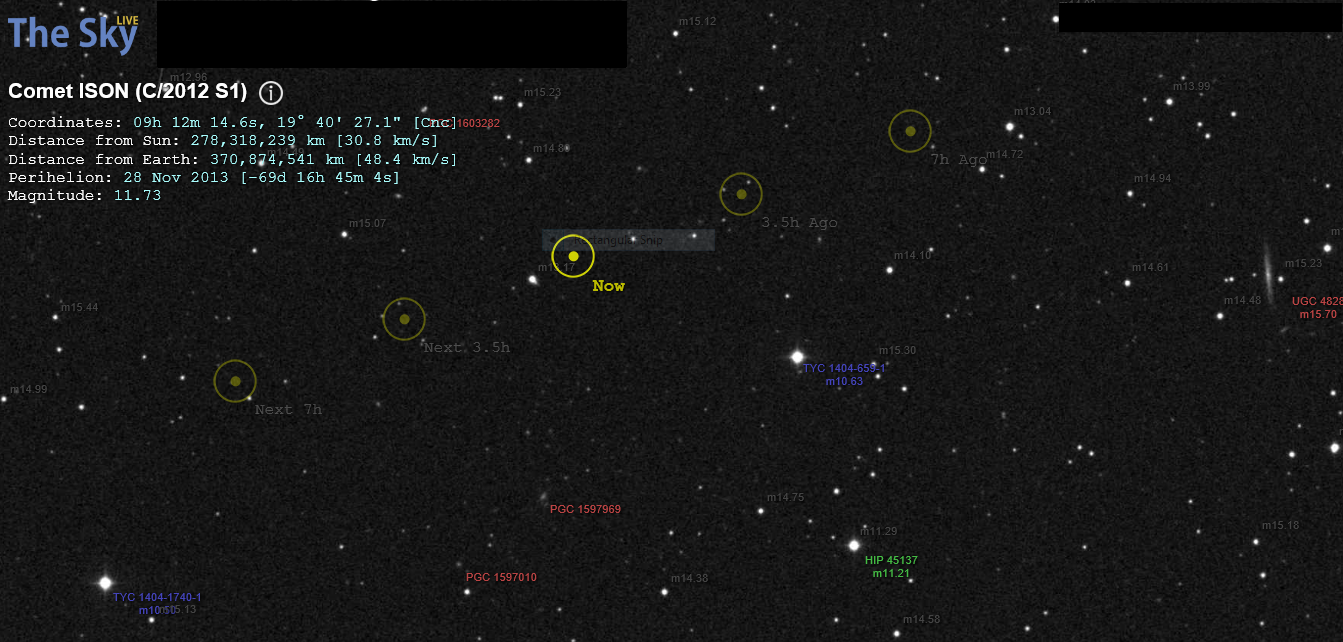
Ison location update 19/09/2013

Question: So where is Ison today?
Simple answer: Space.
Technical answer: 09h 12m 14.6s,   19* 40' 27.1"   (19/09/2012 13:12 GMT)

For those who dont know you can track Ison in real time from the comfort of your computer by visiting the fantastic The Sky live website 

Wednesday, 18 September 2013

New Gif Image of Ison 15/09/2013

This fantastic set of images taken by Bruce Gary and Dennis Whitmer, is easily our favorite so far! 


Comet ISON flying toward the Sun, ​383 million kilometers away from Earth. ​Dennis Whitmer obtained 40 useful images of ISON on the morning of September 15, 2013. Then Bruce Gary used some of those images to create this GIF animation. Image credit: Dennis Whitmer/Bruce Gary

Bruce Gary at his observatory in Arizona, USA

Bruce Gary was the first astronomer to pick up Ison as it emerged from the suns glare, he was not able to see it with his own eyes but by photographing where he expected it to be he was able to build up the composite image above. Well done Bruce, the BCRS salute you!

Photo of Comet Ison 12/09/2013 Taken by the Vatican Observatory

ISON on 12 September 2013

Date: September 12, 2013
Time: 11:41 UT
Direct link: http://www.alpo-astronomy.org/gallery/main.php?g2_itemId=5167
Related information: Comet ISON was approximately 1.993 AU from the sun. That’s over 185+ million mi (298+ million km).
Credits: Carl Hergenrother / University of Arizona / Vatican Observatory