Showing posts with label Ison photograph. Show all posts

Wednesday, 30 October 2013

Photo of Ison by Cliff Spohn & Terry Hancock

This amazing picture of Ison is a joint effort by astrophotographers Cliff Spohn from Ohio and Terry Hancock in Michigan. The image was captured by Cliff using his TEC 140 F7 5" refractor telescope with a QHY9 camera based in Marion, Ohio, while his mate Terry took care of the processing work.
This is not the first collaboration by the pair, You might remember they released a great video of Ison a couple of weeks ago that got us all excited, which you can see here.

Ison by Cliss Spohn & Terry Hancock

Terry Hancock commented “The first time in almost two weeks that we have had a break in the clouds and rain we could not miss this rare opportunity to capture ISON using Cliff’s equipment, Credit goes to Cliff for capturing the object while I did the calibration, stacking in CCDStack post processing in CS5 and video editing.”

Tuesday, 22 October 2013

How to see Ison

OK so you want to see Ison, but how to go about it?

The most important piece of equipment is simply your eyes! This may sound obvious but come the end of November in to December Ison will be more than visible to the naked eye. Ison will appear as a bright point of light low in the sky with a long tail stretching far up in to the heavens, and should be visible all across the northern hemisphere.
McNaught's Comet of 2007
The spectacular picture above is of McNaughts comet also known as "the great comet of 2007". McNaught was visible in the Southern hemisphere. We expect Ison to put on a show of similar scale, so as you can see you really don't need any fancy equipment to enjoy this amazing celestial show!

That said to view Ison before she becomes visible to the naked eye you will need to use optics, as you will if you want to see some of the finer details in her tail, the lumps of material and even jets from her surface.
There obvious choice is to run out and buy a astronomy telescope, but this would be our last choice!
So what are the options? Well it comes down to three, Binoculars, terrestrial telescopes and astronomy telescopes and we rate them in that order, and here why....

Binoculars:

People always over look binoculars when staring out in astronomy, but they are the most useful tool an astronomer can own. Firstly for someone who just wants to catch a glimpse of Ison in all her glory, you really don't want to be spending huge sums of money on a telescope.
A good pair of binoculars cost considerably less than even the cheapest telescope and are not limited to just sky watching! Binoculars are much easier to use, it takes experience and a little skill to locate a distant object with a telescope and even more to keep it tracked on, binoculars make short work of both tasks! The large field of view you get with binoculars make finding objects in the sky easy. The best place to observe anything in the night sky is out in the country, on top of a hill, away from the light pollution of the towns and cities. Unfortunately for astronomers, these are not the easiest places to get to when your carrying a 25kg telescope! No optical device likes being dropped, including binoculars, but we can tell you from experience that telescopes really, REALLY don't like falls! Binoculars on the other hand are designed for "rougher" use. Finally space, not the bit up there but the lack of it in your home! Binoculars take up no room at all and can be kept handy in your cars glove box for those unscheduled comet watching moments! Don't know much about binoculars? Don't worry, scroll down for our buyers guide!
Get a good pair of bins, your back, wallet and sanity will thank you!

Terrestrial Telescopes:

These telescopes are often used for bird watching and are also known as spotter scopes, field telescopes, birding scopes or sports scopes to name but a few. Terrestrial telescopes can be fantastic for comet watching, but do suffer from a lot of the same restrictions that an astronomy telescope does. The advantage's of a terrestrial scope is that they offer higher magnification than binoculars without being to high like a regular telescope. The field of view is also much larger than a regular telescope which makes it easier to locate and stay on objects in the sky. They are much more rugged than an astronomy telescope, smaller, lighter and easier to carry. On the down side though, they are more expensive than binoculars, harder to use, heavier and more awkward to carry and still require a tripod. Our advice is, if you have one or can borrow one take it with you. If not stick with the binoculars.....


Astronomy Telescopes:


Astronomy telescopes are designed to view far space objects, rather than near earth objects like Ison. 
The high magnification and small field of view makes it hard to locate objects in the sky and with the earths rotation, hard to keep in view. 
Telescopes don't come cheap, and the ones that do are usually very poor quality. If you have never used a telescope before, you will probably become frustrated quickly. 

Don't get us wrong telescopes are the backbone of astronomy, but for when Ison comes close, they're to big, to powerful, to clumsy!
Its all about using the right tool the the job........


You might have noticed that we recommend binoculars! But how do you go about choosing a pair? Well don't fret we've written a guide........

Wednesday, 16 October 2013

Fantastic Animation of Ison from Savio Fong of the Galaxy Scientific Group

This amazing GIF animation of Ison was taken by president of the Galaxy Scientific Group, Savio Fong  from his observatory in Tibet on the 13th of October.
Savio Fong is based in Hong Kong but has a remote controlled robotic observatory in Tibet, based at an altitude of 4300m.
Savio is an incredible astrophotographer and has been producing some spectacular images of Ison and we're looking forward to seeing more of his pictures as Ison gets closer to perihelion in the next few weeks!


Ison animation by Savio Fong of the Galaxy Scientific Group

Savio was kind enough to provide details of his set up. The animation was made using twenty, 120 second exposures. He was using a FLI Proline 16803 camera on an APM 105/650 APO refracting telescope, seated on a Paramount ME robotic mount.


IMG_0013.JPG
Savio Fong's Robotic observatory in Tibet

Monday, 14 October 2013

Amazing video of Ison by Cliff Spohn & Terry Hancock

We are really excited today, Cliff Spohn and Terry Hancock of the DownUnder Observatory in the U.S has released the best video of Ison yet! (for those of you wondering why is called the DownUnder Observatory when its in America, Terry was born in the UK before moving to Australia as a child and now lives in the U.S!)

The video is made up of time lapse images shot by Cliff while Terry carried out the processing.


Explaining the video Terry said:
"Here is a time lapse video I created from Cliff's 24 Raw LRGB sub exposures over 72 minutes on friday morning the 11th October. There are varying degrees of brightness due to the interlacing of various filters that we used for the color image"

Terry Hancock is one a our favorite astrophotographers and produces some of the most incredible pictures we've ever seen! You can check out more of his photo's on his website here

Saturday, 12 October 2013

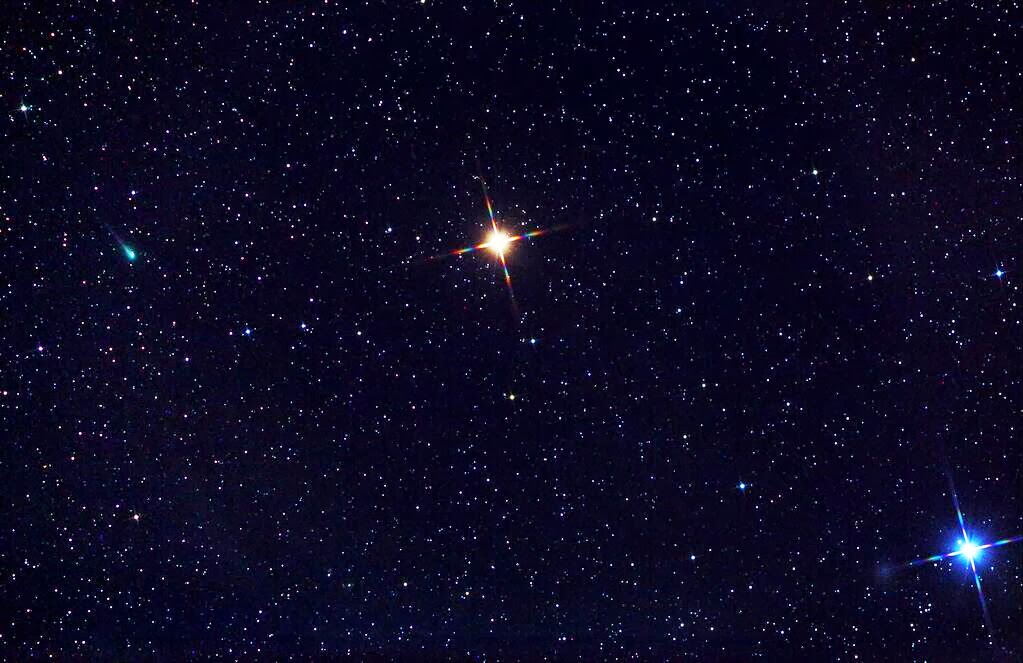
New image of Ison with Mars and Regulus by Norbert Mrozek

This great image of Ison was captured by astronomer Norbert Mrozek and cleaned up by the good people at comet Ison news. You can see Ison to the left of the photo, Mars in the centre while Regulus is to the right. We love the clarity of this shot as well as the glare from Mars!

Ison, Mars and Regulus by Norbert Mrozek

Sunday, 6 October 2013

New photo's of Ison from the Liverpool telescope by Nick Howes

Nick Howes, Ernesto Guido and Martinao Nicolini of theRamanzacco Obsersatory in Itay have been capturing some amazing images of late using the 2m Liverpool telescope. The pictures below are their latest works and show Ison in all her glory! The top image is an enlargement which has been colour corrected. The bottom picture is a stack of twenty, 11 second exposures.

Ison by Nick Howes, Ernesto Guido and Martinao Nicolini

Ison by Nick Howes, Ernesto Guido and Martinao Nicolini


Saturday, 5 October 2013

New photo of Ison by Martin Mobberley

Famous British astronomer Martin Mobberley caputured these fantastic images of Ison.
Martin was using the iTelescope for these pictures. Martin Mobberley is a former president of the British Astronomical Association and currently operates International Astronomical Union Observatory 480. He was honnored by the IAU for his services to astronomy by the renamingof asteroid 7239 to "Mobberley"
He has also written a number of very good books including a biography of Sir Patrick Moore which you can find here.

Ison  05/10/2013   by Martin Mobberley


Ison  04/10/2013   by Martin Mobberley

Thursday, 3 October 2013

Photo of comet Ison and Mars Together

This fantastic image of Ison with the red planet, was taken by Ari Koutsouradis from Maryland, USA.
Ari was kind enough to provide full details of his set up and method to help anyone wanting to photograph Ison for themselves.
The photo is a composite stack of forty four, 30 second exposures at ISO1600. The camera is a Nikon 5000 mounted on a Stellarvue 80ED 80mm refractor telescope which was on a Celestron CG5-ASGT computerised tripod.


Ison with Mars taken by Ari Koutsouradis

Tuesday, 1 October 2013

Ison display's the welcome green glow of Cyanogen gas

There has been a few photo's popping up showing Ison with a green coma (head).
Fear not! Green is a good sign, it shows Ison coma and tail is starting to expand as it gets closer to the Sun.

But what cause's this green glow? It is a gas known as Cyanogen gas which is being released as Ison gets with in reach of the Sun. Cyanogen is normally colourless but it fluoresces green in sunlight a bit like a neon sign. Cyanogen is not just pretty it also smells of almonds, and this might ring alarm bells with those who read murder mysteries! Cyanogen is from the same family as Cyanide and is a poisonous gas. On earth we have nothing to fear what so ever but, we would advise against astronauts removing their helmets and sniffing Ison though as this could only end badly!

Ison showing her green Cyangen coma. Photo taken with a 3 inch telescope on 28/09/2113 by Michael Jaeger

Most comet's contain Cyanogen gas, the most famous of which is Hally's comet. Back in 1910 shortly after discovering the presence of Cyangen in comets people started to worry about the gas. Con-men jumped on the opportunity to sell gas masks and all sorts of pill's and potions, of course all useless! As your reading this your ancestors obviously survived Hally's visit in 1910, and again in 1986 when Hally's comet made her second visit of the 20th century! Take comfort in the fact that NO ONE has ever been harmed by Cyangen or any other gas from a comet. We are looking forward to to the show though, we predict that Ison will only get brighter and greener from here on!


Thursday, 26 September 2013

Ison Photograph clearly showing tail and coma forming nicely!

Photograph of Ison by David Peach showing tail and coma
Photograph of Ison by David Peach


Damian Peach captured this amazing image of Ison on the 24th of September,as she travels between the constellations of Cancer and Leo. David Peach a highly respected British astrophotographer used a 17" corrected Dall-kirkham telescope and a Finger Lakes Instruments Camera. David will be appearing at the Comet Conference by Astronomy Now in London on the 20th of October where he will be sharing his photography tips. For more information visit the Astronomy Now site here


Wednesday, 25 September 2013

Ison Photographed with a 4" refractor telescope


An amatuer astronomer has photographed Ison using just a 4" refracting telescope. Even more amazing is he did it TEN days ago! This is the smallest telescope we've heard of yet viewing Ison, so well done Peter Lawrence!

Peter Lawrence took this photo of Ison with a 4" refractor telescope

"I photographed Comet ISON on Sept. 15th using my 4-inch refractor," reports astrophotographer Pete Lawrence of Selsey UK.  "The comet's tail is nicely on view even through this relatively small instrument."
"Here's a rough stack of images from the morning of 15 September showing Comet C/2012 S1 ISON imaged with a CCD camera through my 4-inch, f/9 refractor."

Have you seen Ison yet? If so we would love to here about your set up!

Sunday, 22 September 2013

Ison location update 22/09/2013


Question: So where is Ison today?
Simple answer: Space.
Technical answer: 09h 18m  13.8s,  19*  08'  42.9"       (22/09/2013  19:30 GMT)

For those who don't know you can track Ison in real time from the comfort of your computer by visiting the fantastic The Sky live website


With thanks to The Sky Live

Wednesday, 18 September 2013

New Gif Image of Ison 15/09/2013

This fantastic set of images taken by Bruce Gary and Dennis Whitmer, is easily our favorite so far! 


Comet ISON flying toward the Sun, ​383 million kilometers away from Earth. ​Dennis Whitmer obtained 40 useful images of ISON on the morning of September 15, 2013. Then Bruce Gary used some of those images to create this GIF animation. Image credit: Dennis Whitmer/Bruce Gary

Bruce Gary at his observatory in Arizona, USA

Bruce Gary was the first astronomer to pick up Ison as it emerged from the suns glare, he was not able to see it with his own eyes but by photographing where he expected it to be he was able to build up the composite image above. Well done Bruce, the BCRS salute you!