Showing posts with label astronomy. Show all posts

Wednesday, 30 October 2013

Time-lapse Video of Ison by Justin Ng

This incredible video of Ison was shot by professional photographer Justin Ng from Mersing, Malaysia. The video is a time-lapse produced over 69 minutes, shot on the 27th of October.
Justin commented that when he first spotted Ison she was glowing bright green "It's my first time seeing a comet and capturing it in motion. It's truly amazing! After I compiled the images and did a time-lapse movie for it, I'm totally in awe and speechless to see the comet moving that fast across the night sky," he said

As the video plays you can see the comet fading, this is due to the fact that the sun was starting to rise and brighting the sky causing Ison to fade from view. Eagle eyed viewers may also spot the galaxy NGC 3428 below and to the left of the two brightest stars on the left of the video.

Please be patient while the video loads, it's well worth the wait!


Normally you would not be able to see Ison moving whilst viewing the comet over such a short period of time, even though she is traveling at around 680,000 KPH but because of the very low field of view of Justins set up it allows us to see her in motion.
Justin explained:
"The primary reason why the comet appears to be moving fast across the sky within 69 minutes is because of the smaller field of view, which makes a very deep space object looks big on the screen and move faster. This is evident if you were to use any planetarium softwares and try to zoom in closely into Comet ISON, you will see its moving faster and faster as the field of view becomes narrower.
I used a 20″ telescope and a specialized monochrome CCD camera to capture it and the field of view is 0.55 degrees. This is extremely narrow and the smaller the field of view, the faster an object will appear to move. Each exposure was only 90 seconds and so when you looked into the time-lapse in the slow motion part, each frame represent the distance covered by Comet ISON within 90 seconds. Which is logical because Comet ISON is traveling at a speed of 684,000kph (425,000mph).
Currently comet is not visible to naked eyes due to its magnitude of about +8.1 and the magnitude of the 2 brightest stars are at around +7, still beyond what naked eyes can see. However there have been reports that the comet is now visible for binoculars and medium-sized telescope.
The images used in the video is what you see in the RAW files. No other editing was done besides cropping the images to fit into 1920 resolution."
Justin Ng is a spectacular photographer with many awards under his belt, his work published by BBC's Sky at Night, National Geographic, ABC, EarthSky, CNN and the Guardian to name just a few! Justin does not limit himself to astrophotography, he actually specializes and is ranked one of the very best in the world at photographing landscapes, sports and especially weddings! So if your tying the knot and fancy the best photographer in the business check out his website here 

Tuesday, 22 October 2013

How to see Ison

OK so you want to see Ison, but how to go about it?

The most important piece of equipment is simply your eyes! This may sound obvious but come the end of November in to December Ison will be more than visible to the naked eye. Ison will appear as a bright point of light low in the sky with a long tail stretching far up in to the heavens, and should be visible all across the northern hemisphere.
McNaught's Comet of 2007
The spectacular picture above is of McNaughts comet also known as "the great comet of 2007". McNaught was visible in the Southern hemisphere. We expect Ison to put on a show of similar scale, so as you can see you really don't need any fancy equipment to enjoy this amazing celestial show!

That said to view Ison before she becomes visible to the naked eye you will need to use optics, as you will if you want to see some of the finer details in her tail, the lumps of material and even jets from her surface.
There obvious choice is to run out and buy a astronomy telescope, but this would be our last choice!
So what are the options? Well it comes down to three, Binoculars, terrestrial telescopes and astronomy telescopes and we rate them in that order, and here why....

Binoculars:

People always over look binoculars when staring out in astronomy, but they are the most useful tool an astronomer can own. Firstly for someone who just wants to catch a glimpse of Ison in all her glory, you really don't want to be spending huge sums of money on a telescope.
A good pair of binoculars cost considerably less than even the cheapest telescope and are not limited to just sky watching! Binoculars are much easier to use, it takes experience and a little skill to locate a distant object with a telescope and even more to keep it tracked on, binoculars make short work of both tasks! The large field of view you get with binoculars make finding objects in the sky easy. The best place to observe anything in the night sky is out in the country, on top of a hill, away from the light pollution of the towns and cities. Unfortunately for astronomers, these are not the easiest places to get to when your carrying a 25kg telescope! No optical device likes being dropped, including binoculars, but we can tell you from experience that telescopes really, REALLY don't like falls! Binoculars on the other hand are designed for "rougher" use. Finally space, not the bit up there but the lack of it in your home! Binoculars take up no room at all and can be kept handy in your cars glove box for those unscheduled comet watching moments! Don't know much about binoculars? Don't worry, scroll down for our buyers guide!
Get a good pair of bins, your back, wallet and sanity will thank you!

Terrestrial Telescopes:

These telescopes are often used for bird watching and are also known as spotter scopes, field telescopes, birding scopes or sports scopes to name but a few. Terrestrial telescopes can be fantastic for comet watching, but do suffer from a lot of the same restrictions that an astronomy telescope does. The advantage's of a terrestrial scope is that they offer higher magnification than binoculars without being to high like a regular telescope. The field of view is also much larger than a regular telescope which makes it easier to locate and stay on objects in the sky. They are much more rugged than an astronomy telescope, smaller, lighter and easier to carry. On the down side though, they are more expensive than binoculars, harder to use, heavier and more awkward to carry and still require a tripod. Our advice is, if you have one or can borrow one take it with you. If not stick with the binoculars.....


Astronomy Telescopes:


Astronomy telescopes are designed to view far space objects, rather than near earth objects like Ison. 
The high magnification and small field of view makes it hard to locate objects in the sky and with the earths rotation, hard to keep in view. 
Telescopes don't come cheap, and the ones that do are usually very poor quality. If you have never used a telescope before, you will probably become frustrated quickly. 

Don't get us wrong telescopes are the backbone of astronomy, but for when Ison comes close, they're to big, to powerful, to clumsy!
Its all about using the right tool the the job........


You might have noticed that we recommend binoculars! But how do you go about choosing a pair? Well don't fret we've written a guide........

Friday, 18 October 2013

Photo of comet Ison and Mars Together

This fantastic image of Ison with the red planet, was taken by Ari Koutsouradis from Maryland, USA.
Ari was kind enough to provide full details of his set up and method to help anyone wanting to photograph Ison for themselves.
The photo is a composite stack of forty four, 30 second exposures at ISO1600. The camera is a Nikon 5000 mounted on a Stellarvue 80ED 80mm refractor telescope which was on a Celestron CG5-ASGT computerised tripod.


Ison with Mars taken by Ari Koutsouradis

Monday, 14 October 2013

Amazing video of Ison by Cliff Spohn & Terry Hancock

We are really excited today, Cliff Spohn and Terry Hancock of the DownUnder Observatory in the U.S has released the best video of Ison yet! (for those of you wondering why is called the DownUnder Observatory when its in America, Terry was born in the UK before moving to Australia as a child and now lives in the U.S!)

The video is made up of time lapse images shot by Cliff while Terry carried out the processing.


Explaining the video Terry said:
"Here is a time lapse video I created from Cliff's 24 Raw LRGB sub exposures over 72 minutes on friday morning the 11th October. There are varying degrees of brightness due to the interlacing of various filters that we used for the color image"

Terry Hancock is one a our favorite astrophotographers and produces some of the most incredible pictures we've ever seen! You can check out more of his photo's on his website here

Sunday, 6 October 2013

Ison Location Update 06/10/2013


These are the current co-ordinates for Ison at 18:50 GMT  06/10/2013

Click here for Ison's position on a sky map

Co-ordinates: 09h  47m  30.8s    16*  20'  18.4"
Distance from Sun: 230,379,972 km
Distance from Earth: 296,098,153 km
Magnitude: 10.69

For those who don't know you can track Ison in real time from the comfort of your computer by visiting the fantastic The Sky live website

With thanks to The Sky Live

Thursday, 3 October 2013

Photo of comet Ison and Mars Together

This fantastic image of Ison with the red planet, was taken by Ari Koutsouradis from Maryland, USA.
Ari was kind enough to provide full details of his set up and method to help anyone wanting to photograph Ison for themselves.
The photo is a composite stack of forty four, 30 second exposures at ISO1600. The camera is a Nikon 5000 mounted on a Stellarvue 80ED 80mm refractor telescope which was on a Celestron CG5-ASGT computerised tripod.


Ison with Mars taken by Ari Koutsouradis

Wednesday, 2 October 2013

Ison Location Update 01/10/2013

These are the current co-ordinates for Ison at 19.36 GMT  02/10/2013

Co-ordinates: 09h  38m  29.3s    17*  14'  32.2"
Distance from Sun: 241,832,405 km
Distance from Earth: 313,735,498 km
Magnitude: 10.97

For those who don't know you can track Ison in real time from the comfort of your computer by visiting the fantastic The Sky live website

With thanks to The Sky Live

First photo's of Ison taken from Mars

At last NASA has released the first photo's of Ison taken from the Mars Reconnaissance Orbiter!
Using the HiRISE camera NASA's MRO took four photo's of Ison from a distance of 13.8 million km (8.5 million miles) on the 29th of September as Ison made her approach to Mars. The photo below is an enlarged image of one of the photo's, the first of Ison taken by MRO while orbiting Mars. The grainy image shows Ison as the blob of light in the centre.

Ison image taken by Mars Reconnaissance Orbiter's HiRISE camera (NASA/JPL/University of Arizona)
Alan Delamere and Alfred McEwen, HiRISE researchers gave the follow statement in a press release:
HiRISE researchers Alan Delamere and Alfred McEwen explained in a news release:

Based on preliminary analysis of the data, the comet appears to be at the low end of the range of brightness predictions for the observation. As a result, the image isn’t visually pleasing but low coma activity is best for constraining the size of the nucleus. This image has a scale of approximately 8 miles (13.3 km) per pixel, larger than the comet, but the size of the nucleus can be estimated based on the typical brightness of other comet nuclei. The comet, like Mars, is currently 241 million kilometers from the Sun. As the comet gets closer to the sun, its brightness will increase to Earth-based observers and the comet may also become intrinsically brighter as the stronger sunlight volatilizes the comet’s ices.


Ison image's taken by Mars Reconnaissance Orbiter's HiRISE camera 29/09/2013 (NASA/JPL/University of Arizona)


NASA's MRO using it's HiRISE camera is thought to have captured more images as Ison reached it's closest point with Mars yesterday, hopefully they will be releasing these images soon. Unfortunately NASA has been caught up in the US government shutdown, so we are unable to predict when we will get to see them. We hope this situation is sorted out quickly, but until then these images have really wetted our appetite for the picture's to come!

Monday, 30 September 2013

NASA Prepares for Ison's flyby of Mars

Tomorrow see's Ison reach it's closest approach to Mars. Ison is going to come within just 10,460,730 km of Mars, six times closer than it will get to Earth!
There are currently 5 active Mars missions which will be turning their attention towards Ison, 2 rovers and 3 orbiters. The best equipped to study Ison are NASA's Mars Reconnaissance Orbiter (MRO) and ESA's Mars Express Orbiter (MEO).


Artists impression of Ison from the surface ofMars

Mars Reconnaissance is equipped with the largest telescope ever taken in to deep space at 20 inches, however it was designed with surface observation, rather than imaging comets! Like wise Mars Express original purpose is also terrestrial mapping and comes equipped with the very impressive HRSC Camera. Between them MRO and MEO should give us some stunning pictures and the most in depth data on Ison so far.  We are hoping to get much more accurate data on her size, the larger she is the more likely she will survive her encounter with the Sun at the end of November.
What's more as she passes Mars she is warming up more causing her tail to grow and increasing her coma. With all these orbiters and rovers pointed in her direction, we should get a fascinating glimpse in to how chunks of ice evolve and grow into the magnificent comets we all know!

Mars Reconnaissance Orbiter


All of this is just a small part of the research being conducted on Ison. A grand total of 16 NASA craft will be observing Ison from space along with the Hubble space telescope, 4 ESA spacecraft and every observatory on Earth! Ison is without doubt the most study comet there has ever been, and we are extremely excited to find out what secrets will be unlocked!


Friday, 27 September 2013

Ison location update 27/09/2013


These are the current co-ordinates for Ison at 20.23 GMT  27/09/2013

Co-ordinates: 09h 28m 02.7s,   18* 14'  44.1"
Distance from Sun: 255,804,818 km
Distance from Earth: 335,506,810 km
Magnitude: 11.32

For those who don't know you can track Ison in real time from the comfort of your computer by visiting the fantastic The Sky live website

With thanks to The Sky Live

A Newbies guide to Ison part 4

What is Perihelion?

Perihelion is term we use to mean that a comet has reached its closest point to the sun. Comet Ison's perihelion is on the 28th of November at approximately 23:00 GMT when she will pass the Sun at a distance of around 1,200,000 Km (800,000 miles)


What is A.U?

A.U is a measurement of distance, and stands for Astronomical Unit.
A.U is the distance between the Earth and the Sun which is 149,597,870,700 km (92,955,807,273 miles). So if you see Ison's distance from earth as 2.0 A.U this means it is twice as far away as the Earth is from the Sun. 

Thursday, 19 September 2013

Ison location update 19/09/2013

Question: So where is Ison today?
Simple answer: Space.
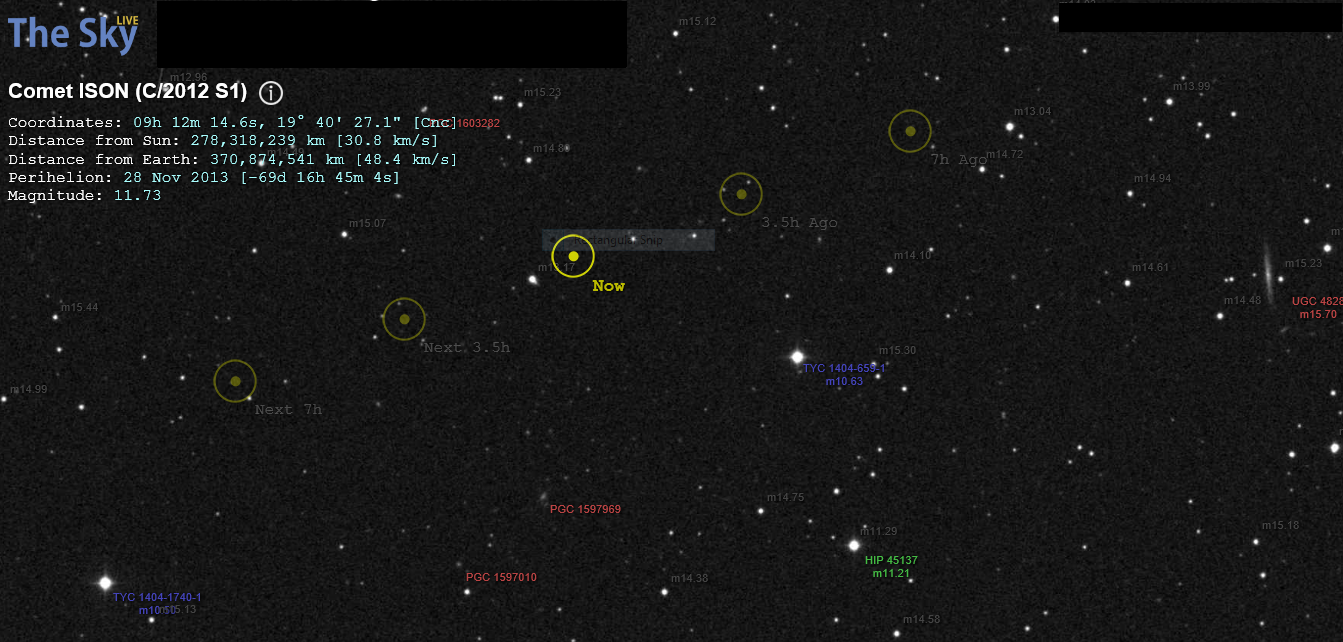
Technical answer: 09h 12m 14.6s,   19* 40' 27.1"   (19/09/2012 13:12 GMT)

For those who dont know you can track Ison in real time from the comfort of your computer by visiting the fantastic The Sky live website