 |
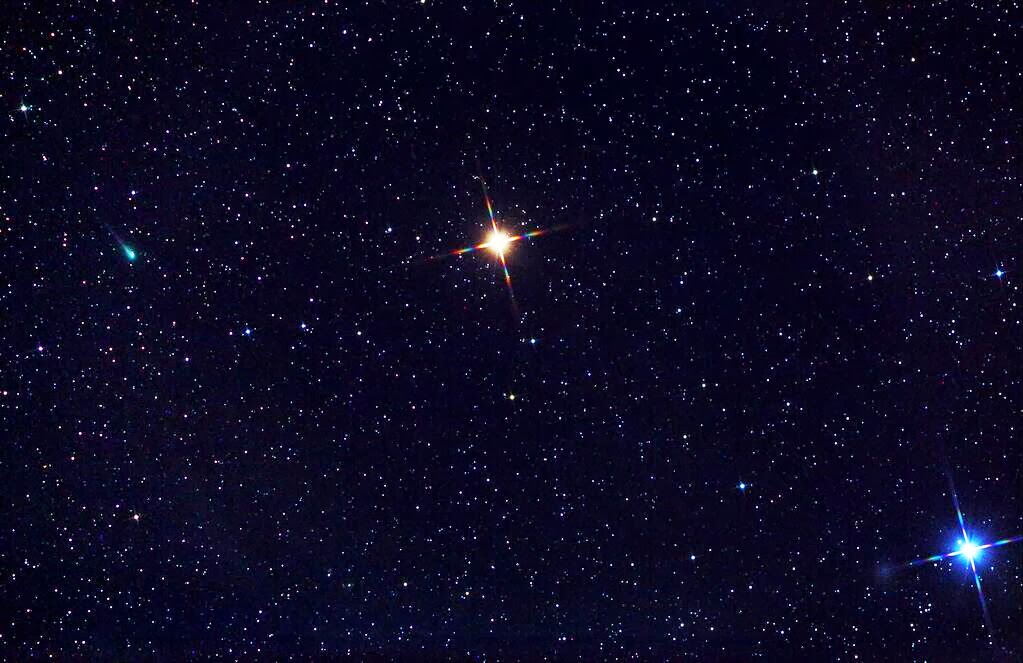
| Ison, Mars and Regulus by Norbert Mrozek |

Official blog of the British Comet Research Society, bringing you Expert Knowledge in Layman's Terms
Showing posts with label what is isons. Show all posts
Showing posts with label what is isons. Show all posts
Saturday, 12 October 2013
New image of Ison with Mars and Regulus by Norbert Mrozek
This great image of Ison was captured by astronomer Norbert Mrozek and cleaned up by the good people at comet Ison news. You can see Ison to the left of the photo, Mars in the centre while Regulus is to the right. We love the clarity of this shot as well as the glare from Mars!

Saturday, 28 September 2013
Ison Location Update 28/09/2013
These are the current co-ordinates for Ison at 19.25 GMT 28/09/2013
Co-ordinates: 09h 29m 59.8s, 18* 03' 41.1"
Distance from Sun: 253,134,203 km
Distance from Earth: 331,329,671 km
Magnitude: 11.25
For those who don't know you can track Ison in real time from the comfort of your computer by visiting the fantastic The Sky live website
Co-ordinates: 09h 29m 59.8s, 18* 03' 41.1"
Distance from Sun: 253,134,203 km
Distance from Earth: 331,329,671 km
Magnitude: 11.25
For those who don't know you can track Ison in real time from the comfort of your computer by visiting the fantastic The Sky live website
 |
| With thanks to The Sky Live |
Wednesday, 25 September 2013
Comet Ison location update 25/09/2013
These are the current co-ordinates for Ison at 19:15 GMT 25/09/2013
Co-ordinates: 09h 23m 58.7s, 18* 37' 27.0"
Distance from Sun: 261,454,125 km
Distance from Earth: 344,360,900 km
Magnitude: 11.45
For those who don't know you can track Ison in real time from the comfort of your computer by visiting the fantastic The Sky live website
Co-ordinates: 09h 23m 58.7s, 18* 37' 27.0"
Distance from Sun: 261,454,125 km
Distance from Earth: 344,360,900 km
Magnitude: 11.45
For those who don't know you can track Ison in real time from the comfort of your computer by visiting the fantastic The Sky live website
 |
| Ison's current location 25/09/2013 with thanks to The Sky Live |
Monday, 23 September 2013
A newbies guide to Ison part 3
How fast is Ison?
Ison is moving fast! As of September she is traveling at approximately 107826 kph (67,000 mph), at this speed it would take Ison just 10 seconds to travel the entire length of the M1 motorway!
Where did Ison come from?
We believe Ison came from the Oort cloud. Our solar system sits inside a large ball shaped cloud of ice and rocks. This is the Oort cloud and is generally considered to be the boundary of the solar system and the birth place of most comets. 
You may notice on the picture above that the cloud has two parts, the inner cloud and the outer cloud. Imagine a football with a dinner plate inside. The outer cloud is where we think Ison came from. The Oort cloud contains trillions of frozen objects, mainly water, ammonia and methane.
What is Ison's mass?
How close to earth will Ison get?

Subscribe to:
Comments (Atom)