Showing posts with label ison photo. Show all posts

Wednesday, 30 October 2013

Photo of Ison by Cliff Spohn & Terry Hancock

This amazing picture of Ison is a joint effort by astrophotographers Cliff Spohn from Ohio and Terry Hancock in Michigan. The image was captured by Cliff using his TEC 140 F7 5" refractor telescope with a QHY9 camera based in Marion, Ohio, while his mate Terry took care of the processing work.
This is not the first collaboration by the pair, You might remember they released a great video of Ison a couple of weeks ago that got us all excited, which you can see here.

Ison by Cliss Spohn & Terry Hancock

Terry Hancock commented “The first time in almost two weeks that we have had a break in the clouds and rain we could not miss this rare opportunity to capture ISON using Cliff’s equipment, Credit goes to Cliff for capturing the object while I did the calibration, stacking in CCDStack post processing in CS5 and video editing.”

Friday, 18 October 2013

Photo of comet Ison and Mars Together

This fantastic image of Ison with the red planet, was taken by Ari Koutsouradis from Maryland, USA.
Ari was kind enough to provide full details of his set up and method to help anyone wanting to photograph Ison for themselves.
The photo is a composite stack of forty four, 30 second exposures at ISO1600. The camera is a Nikon 5000 mounted on a Stellarvue 80ED 80mm refractor telescope which was on a Celestron CG5-ASGT computerised tripod.


Ison with Mars taken by Ari Koutsouradis

Saturday, 12 October 2013

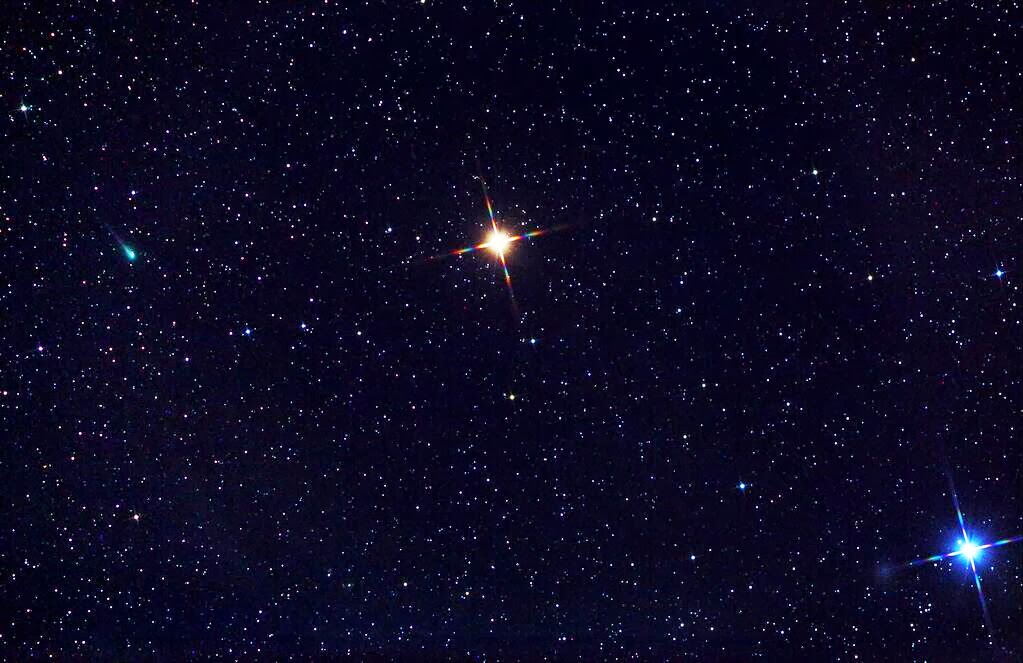
New image of Ison with Mars and Regulus by Norbert Mrozek

This great image of Ison was captured by astronomer Norbert Mrozek and cleaned up by the good people at comet Ison news. You can see Ison to the left of the photo, Mars in the centre while Regulus is to the right. We love the clarity of this shot as well as the glare from Mars!

Ison, Mars and Regulus by Norbert Mrozek

Sunday, 6 October 2013

New photo's of Ison from the Liverpool telescope by Nick Howes

Nick Howes, Ernesto Guido and Martinao Nicolini of theRamanzacco Obsersatory in Itay have been capturing some amazing images of late using the 2m Liverpool telescope. The pictures below are their latest works and show Ison in all her glory! The top image is an enlargement which has been colour corrected. The bottom picture is a stack of twenty, 11 second exposures.

Ison by Nick Howes, Ernesto Guido and Martinao Nicolini

Ison by Nick Howes, Ernesto Guido and Martinao Nicolini


Saturday, 5 October 2013

New photo of Ison by Martin Mobberley

Famous British astronomer Martin Mobberley caputured these fantastic images of Ison.
Martin was using the iTelescope for these pictures. Martin Mobberley is a former president of the British Astronomical Association and currently operates International Astronomical Union Observatory 480. He was honnored by the IAU for his services to astronomy by the renamingof asteroid 7239 to "Mobberley"
He has also written a number of very good books including a biography of Sir Patrick Moore which you can find here.

Ison  05/10/2013   by Martin Mobberley


Ison  04/10/2013   by Martin Mobberley

Thursday, 3 October 2013

Photo of comet Ison and Mars Together

This fantastic image of Ison with the red planet, was taken by Ari Koutsouradis from Maryland, USA.
Ari was kind enough to provide full details of his set up and method to help anyone wanting to photograph Ison for themselves.
The photo is a composite stack of forty four, 30 second exposures at ISO1600. The camera is a Nikon 5000 mounted on a Stellarvue 80ED 80mm refractor telescope which was on a Celestron CG5-ASGT computerised tripod.


Ison with Mars taken by Ari Koutsouradis

Does this Photo show jets on Ison?

On Tuesday Ernesto Guido, Nick Howes and Martinao Nicolini of the Ramanzacco Observatory in Italy managed to capture the image below using the 2 metre Liverpool telescope. One of the images appear to show what is maybe a jet from Ison. Jets are formed as a comet approaches our Sun, it begins to heat up and the ice begins to change from a solid to a gas with no liquid stage. Some of the dust is left behind as the ice melts. The dust forms a dark, protective crust on the surface of the nucleus (head) and slows the melting. In some places this layer is thinner, which allows jets of gas to burst through.

Ison captured with Mars Ernesto Guido, Nick Howes and Martinao Nicolini at the Ramanzacco Observatory, Italy.

The image is a stack of twenty, 11 second exposures and clearly shows Ison developing coma and tail which is now estimated to measure at least 3 arc minutes. This is a very promising sign that Ison is developing into the comet we have been hoping for.
Talking about the image Nick Howes said: "There was some debate as to the existence of additional jet structures on the comet. Our data analysis seems to show that some reports of this were possibly spurious, however, our one process does seem to show a possible small jet, which a 2m class instrument would be able to detect. Our analysis is undergoing additional review and peer checking with our collaborators in the USA. The scientific analysis of this comet and its inner coma is ongoing, and being monitored closely."
The team at the Ramanzacco observatory have sent the images and data to the Planetary Science Institute for further analysis, and we hope to bring an update later today!

Tuesday, 1 October 2013

Ison display's the welcome green glow of Cyanogen gas

There has been a few photo's popping up showing Ison with a green coma (head).
Fear not! Green is a good sign, it shows Ison coma and tail is starting to expand as it gets closer to the Sun.

But what cause's this green glow? It is a gas known as Cyanogen gas which is being released as Ison gets with in reach of the Sun. Cyanogen is normally colourless but it fluoresces green in sunlight a bit like a neon sign. Cyanogen is not just pretty it also smells of almonds, and this might ring alarm bells with those who read murder mysteries! Cyanogen is from the same family as Cyanide and is a poisonous gas. On earth we have nothing to fear what so ever but, we would advise against astronauts removing their helmets and sniffing Ison though as this could only end badly!

Ison showing her green Cyangen coma. Photo taken with a 3 inch telescope on 28/09/2113 by Michael Jaeger

Most comet's contain Cyanogen gas, the most famous of which is Hally's comet. Back in 1910 shortly after discovering the presence of Cyangen in comets people started to worry about the gas. Con-men jumped on the opportunity to sell gas masks and all sorts of pill's and potions, of course all useless! As your reading this your ancestors obviously survived Hally's visit in 1910, and again in 1986 when Hally's comet made her second visit of the 20th century! Take comfort in the fact that NO ONE has ever been harmed by Cyangen or any other gas from a comet. We are looking forward to to the show though, we predict that Ison will only get brighter and greener from here on!


Thursday, 26 September 2013

Ison Photograph clearly showing tail and coma forming nicely!

Photograph of Ison by David Peach showing tail and coma
Photograph of Ison by David Peach


Damian Peach captured this amazing image of Ison on the 24th of September,as she travels between the constellations of Cancer and Leo. David Peach a highly respected British astrophotographer used a 17" corrected Dall-kirkham telescope and a Finger Lakes Instruments Camera. David will be appearing at the Comet Conference by Astronomy Now in London on the 20th of October where he will be sharing his photography tips. For more information visit the Astronomy Now site here


Sunday, 22 September 2013

Ison location update 22/09/2013


Question: So where is Ison today?
Simple answer: Space.
Technical answer: 09h 18m  13.8s,  19*  08'  42.9"       (22/09/2013  19:30 GMT)

For those who don't know you can track Ison in real time from the comfort of your computer by visiting the fantastic The Sky live website


With thanks to The Sky Live

Wednesday, 18 September 2013

New Gif Image of Ison 15/09/2013

This fantastic set of images taken by Bruce Gary and Dennis Whitmer, is easily our favorite so far! 


Comet ISON flying toward the Sun, ​383 million kilometers away from Earth. ​Dennis Whitmer obtained 40 useful images of ISON on the morning of September 15, 2013. Then Bruce Gary used some of those images to create this GIF animation. Image credit: Dennis Whitmer/Bruce Gary

Bruce Gary at his observatory in Arizona, USA

Bruce Gary was the first astronomer to pick up Ison as it emerged from the suns glare, he was not able to see it with his own eyes but by photographing where he expected it to be he was able to build up the composite image above. Well done Bruce, the BCRS salute you!

Photo of Comet Ison 12/09/2013 Taken by the Vatican Observatory

ISON on 12 September 2013

Date: September 12, 2013
Time: 11:41 UT
Direct link: http://www.alpo-astronomy.org/gallery/main.php?g2_itemId=5167
Related information: Comet ISON was approximately 1.993 AU from the sun. That’s over 185+ million mi (298+ million km).
Credits: Carl Hergenrother / University of Arizona / Vatican Observatory