Friday, 18 October 2013

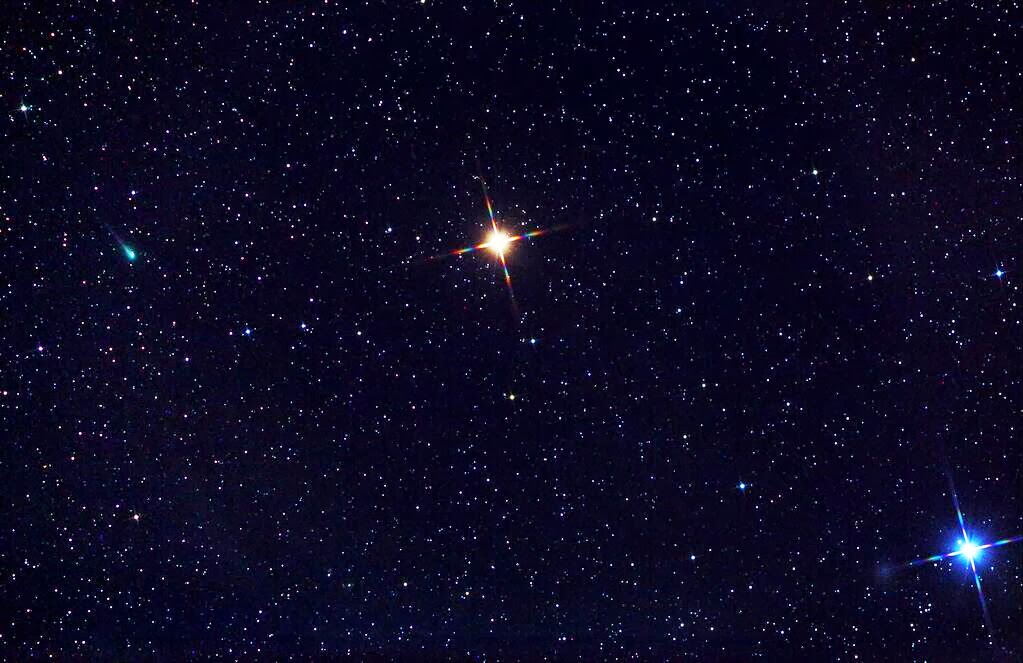
Photo of comet Ison and Mars Together

This fantastic image of Ison with the red planet, was taken by Ari Koutsouradis from Maryland, USA.
Ari was kind enough to provide full details of his set up and method to help anyone wanting to photograph Ison for themselves.
The photo is a composite stack of forty four, 30 second exposures at ISO1600. The camera is a Nikon 5000 mounted on a Stellarvue 80ED 80mm refractor telescope which was on a Celestron CG5-ASGT computerised tripod.


Ison with Mars taken by Ari Koutsouradis

Wednesday, 16 October 2013

Fantastic Animation of Ison from Savio Fong of the Galaxy Scientific Group

This amazing GIF animation of Ison was taken by president of the Galaxy Scientific Group, Savio Fong  from his observatory in Tibet on the 13th of October.
Savio Fong is based in Hong Kong but has a remote controlled robotic observatory in Tibet, based at an altitude of 4300m.
Savio is an incredible astrophotographer and has been producing some spectacular images of Ison and we're looking forward to seeing more of his pictures as Ison gets closer to perihelion in the next few weeks!


Ison animation by Savio Fong of the Galaxy Scientific Group

Savio was kind enough to provide details of his set up. The animation was made using twenty, 120 second exposures. He was using a FLI Proline 16803 camera on an APM 105/650 APO refracting telescope, seated on a Paramount ME robotic mount.


IMG_0013.JPG
Savio Fong's Robotic observatory in Tibet

Monday, 14 October 2013

Amazing video of Ison by Cliff Spohn & Terry Hancock

We are really excited today, Cliff Spohn and Terry Hancock of the DownUnder Observatory in the U.S has released the best video of Ison yet! (for those of you wondering why is called the DownUnder Observatory when its in America, Terry was born in the UK before moving to Australia as a child and now lives in the U.S!)

The video is made up of time lapse images shot by Cliff while Terry carried out the processing.


Explaining the video Terry said:
"Here is a time lapse video I created from Cliff's 24 Raw LRGB sub exposures over 72 minutes on friday morning the 11th October. There are varying degrees of brightness due to the interlacing of various filters that we used for the color image"

Terry Hancock is one a our favorite astrophotographers and produces some of the most incredible pictures we've ever seen! You can check out more of his photo's on his website here

Saturday, 12 October 2013

Ison GIF from NASA's STEREO-A spacecraft

Is animated GIF is of comet Ison comes from the NASA Comet Ison Observing Campaign and was taken by NASA's STEREO-A spacecraft using the SECCHI HI-2 camera. STEREO-A is is now the 7th spacecraft to view Ison and will continue to observe her right through to January.

The image is made up from photo's taken on the 10th and 11th of October and was put together by Karl at the CIOC. Karl is very critical of his work but we're sure you'll agree he did an excellent job!

Ison can be seen between the red lines. Ison GIF by Karl of the CIOC taken by the STEREO-A 

Explaining the GIF Karl said:
"Obviously comet ISON appears very small right now, as it is a long distance from the spacecraft, and the pixels in that image are very big. By that, I mean that each pixel of the image actually contains a fairly significant chunk of sky. By my very rough estimates based on previous experience with comets in that camera, I'd say ISON is somewhere around mag 10 -- which is more-or-less what ground observers are beginning to see, too. Also visible in the image are lots of bright blobs -- those are stars. Finally, that funny wedge-shaped thing is something we placed in the instrument field of view for early during the STEREO mission (back in 2007-ish) when the Earth was in the field of view and would have blinded the camera if not for that little wedge. "


NASA's STEREO spacecraft


The CIOC are still processing the data from the STEREO-A mission and are hoping to release more pictures in the next few days. In addition to the STEREO-A spacecraft there is also a STEREO-B craft and ISON should becoming in to it's view in a few weeks! 
NASA's STEREO Mission was launched in 2006 to study coronal mass ejections from the Sun. The mission consists of 2 craft A and B, one craft travels ahead of Earths orbit while the other follows. STEREO stands for Solar TErrestrial RElations Observatory and both craft are fitted with an extreme ultraviolet imager, two white-light coronagraphs and a heliospheric imager.


New image of Ison with Mars and Regulus by Norbert Mrozek

This great image of Ison was captured by astronomer Norbert Mrozek and cleaned up by the good people at comet Ison news. You can see Ison to the left of the photo, Mars in the centre while Regulus is to the right. We love the clarity of this shot as well as the glare from Mars!

Ison, Mars and Regulus by Norbert Mrozek

Wednesday, 9 October 2013

New reseach shows Ison Will survive the Sun and will put on a show!

Great news for astronomers await Ison.... it looks like Ison will survive her encounter with the Sun, and will put on quite a show doing it! Today we have heard the conclusions from two separate research teams who have been studying Ison, and both have good news!

Planetary Science Institute scientist Dr Jian Yang Li, has been tasked with studying Ison.
Dr Jian Yang Li who is a world leading comet expert and has worked with NASA on the Deep Impact and Dawn missions, presented his research findings which were funded by NASA and the Space Telescope Science Institute to the American Astronomical Society's division for planetary sciences 45th Annual Meeting in Denver.

Dr Jian Yang Li said:
“We measured the rotational pole of the nucleus. The pole indicates that only one side of the comet is being heated by the sun on its way in until approximately one week before it reaches it closest point to the sun,
Since the surface on the dark side of the comet should still retain a large fraction of very volatile materials, the sudden exposure to the strong sunlight when it gets closer to the sun than Mercury could trigger huge outbursts of material. We measured the color of the coma, and found that the outer part of the coma is slightly redder than the inner part, This color change is unusual in comets, and seems to imply that the inner part contains some water ice grains, which sublimate as they move away from the nucleus.”
“As a first-time visitor to the inner solar system, Comet C/ISON provides astronomers a rare opportunity to study a fresh comet preserved since the formation of the Solar System, The expected high brightness of the comet as it nears the sun allows for many important measurements that are impossible for most other fresh comets.”


This image shows the color change of Comet C/ISON’s dust coma. The white dot at the center of the coma marks the location of the nucleus. ISON’s dust coma appears to be less red near the nucleus than it is further away from the nucleus. Although the color change is actually very small, it could be an indication of relatively more water ice particles near the nucleus. Those icy particles evaporate, as they move outward, makes the coma appear redder.


In a separate study by scientists at the Lowell Observatory and Southwest Research Institute (SwRI).
funded by NASA's Lunar Science Institute, carried out new numerical simulations and interpreted them using data from the historical records of  Sun-grazing comet behavior.

Dr Kevin Walsh, a research scientist in SwRI's Planetary Science Directorate at Boulder, Colorado said:
"A major part of our work was to test if the encounter with the Sun would provide enough of a spin increase to pull material off the surface of the comet, When the comet passes near the Sun, it feels the tidal forces pulling on it, and it also gets a slight spin increase due to this rapid flyby. This spin increase is in the prograde direction, so if the comet is already spinning prograde, then it's just that much closer to spinning fast enough to lose mass.A non-spinning or retrograde (back-spinning) comet is more likely to survive because the "backspin" cancels out some of the tidal forces nearest the Sun. The opposite effect would be seen if the comet were spinning prograde, similar to a tennis ball with topspin. In that case, the spin direction would increase the tidal forces at the surface nearest the Sun and aggravate the disruptive potential, even for a comet of far greater density. The faster the prograde rotation and the lower its density, the greater the chances of a comet's disruption."


There has been a lot of speculation of late that Ison will not be as bright as previously thought. This research by the Planetary Science Institute shows that as Ison is not spinning as fast as we would normally expect a comet too. This means that some where in the region of half the ice and gasses that make up the tail are still locked up and waiting to be set free. It is these gases that make up the comets tail and coma.  The study by the Lowell Observatory and Southwest Research Institute has given us new hope that Ison WILL survive its encounter with the sun and backs up the finds by the PSI. All in all today has been full of great news of astronomers across the world!


Tuesday, 8 October 2013

ESA's SOHO Spacecraft image of Ison


With the US shutdown there has been a lack of images coming from NASA, which is particularly disappointing as last week Ison made her closest pass to Mars. Luckily the European Space Agency (ESA) is still up and running and releasing images! The ESA's Solar and Heliospheric Observatory or SOHO for short is a satellite that was launched in 1995 to study the Sun with a variety of on board instruments.Originally the SOHO mission was only going to last a couple of years but due to the amazing results it was producing it is still running today.


The SOHO craft is fitted with a special instrument called SWAN (Solar Wind ANisotrpies) which is the only instrument on board not to be pointed at the Sun, instead it looks at everything else! Swan watches the rest of the sky, measuring hydrogen that is ‘blowing’ into the Solar System from interstellar space. 
By studying the interaction between the solar wind and this hydrogen gas, SWAN determines how the solar wind is distributed. The ESA have used SWAN to detect the hydrogen in Ison's coma, which should be able to tell us how much water is being produced and at what rate. The data from SWAN should give us great new insights in to the emissions given off by sun grazing comets like Ison.

Ison captured by European Space Agency's SOHO craft using the SWAN instrument

The image above is the first image of Ison taken by SWAN to be released by the ESA, over the next few weeks as Ison brightens we should get ever more impressive pictures. Swan takes 360 degree images of space the only thing it doesn't picture is the Sun and the Earth, which are the dark spots on the image. What SWAN is photographing is the effect that solar wind has on the element hydrogen. Sounds complicated but its quite simple really, imagine you wanted to take a picture of the wind, but you cant see it. So you photograph the effect the wind has blowing dust on the ground or on the leaves of a tree, this is basically what SWAN does! Instead of dust and leaves it photographs the effect on hydrogen by the solar wind. What makes this camera particularly important for studying Ison is that because it basically photographs hydrogen, we can tell how much hydrogen is being given off by Ison, which is the main make up of a comets coma and tail. Now even we will admit that this image is not the most spectacular of Ison we've seen, but as Ison gets closer to the sun and more hydrogen is given off  her coma and tail will expand and the images by SWAN will get bigger and better and the data will be invaluable!